Research news
A research team at the Medical University of Vienna has outlined a new direction in drug discovery that focuses on fine-tuning how cells transmit signals, with the aim of improving treatment precision and reducing unwanted effects.
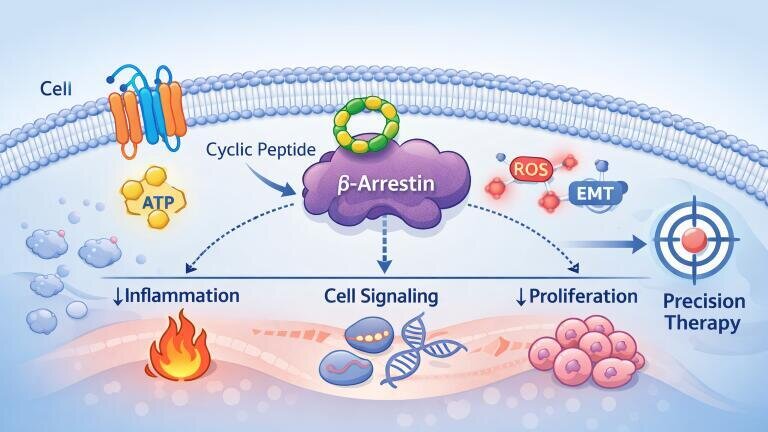
Published in Trends in Pharmacological Sciences [1], the review explores the growing potential of β-arrestins - key regulatory proteins involved in cellular communication - as underused but highly promising targets for future therapies. These proteins act as molecular ‘switchboards’, shaping how signals are relayed inside cells, and are increasingly linked to a range of diseases, including neurological disorders.
Led by Christian Gruber at MedUni Vienna’s Center for Physiology and Pharmacology, the authors describe how emerging peptide-based approaches could offer a more selective way to influence these signalling networks. Unlike conventional drugs that often affect multiple pathways at once, specially designed peptides can be engineered to interact with precise molecular targets.
The review highlights cyclic peptides - ring-shaped molecules inspired by natural compounds - as particularly promising candidates. Their compact, stable structure makes them well suited to engaging difficult targets such as receptors and arrestins, and potentially even crossing biological barriers relevant to brain disorders.
The researchers also discuss how computational design and chemical screening are accelerating the development of these molecules, enabling highly tailored compounds that may one day support more personalised treatment strategies.
According to the team, this approach could open new therapeutic possibilities for conditions such as Alzheimer’s disease and glioblastoma, where precise control of signalling pathways is critical. Work is now focusing on improving peptide stability and delivery to ensure they can reach their targets effectively within the body.
More information online
ILM 51.6 Sept 2026




 Product directory


.jpg)

















,-photo-Karin-Allander.jpg)