Research news
A protein present in organisms as ancient as sponges and jellyfish – roughly 600–800 million years – has been shown to shape how well cancer immunotherapy works
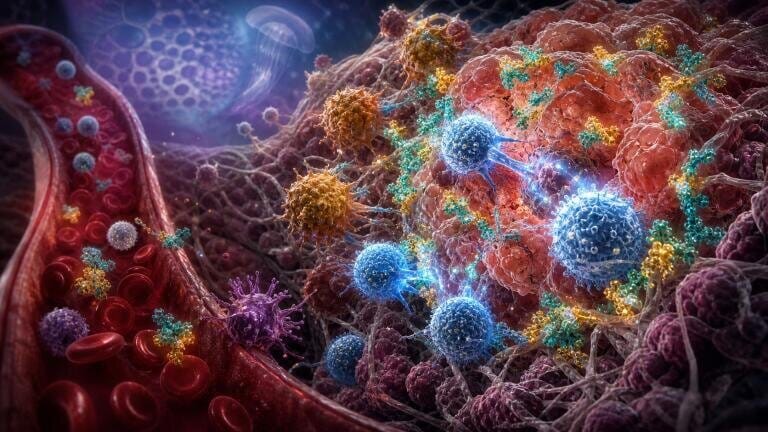
A molecule that predates the evolution of the blood circulation system has been found to support the effectiveness of cancer immunotherapy. Researchers at Nagoya University in Japan discovered that complement C3 – a protein with origins reaching back to simple organisms such as sponges and jellyfish – acts inside tumours to prevent the build-up of immune-suppressing cells but only when the protein is produced within the tumour itself.
C3 which was freely circulating in the blood was shown to have no bearing on treatment outcomes. The findings suggest that artificially recreating this local effect could help patients whose tumours do not naturally produce enough of the protein.
Complement C3 is produced mainly in the liver and plays a well‑established role in the body’s immune defences, travelling through the bloodstream to protect against infection. Its function when produced locally in tissues and organs, however, has been far less well understood.
“Cancer tumours are surrounded by normal cells called fibroblasts. Until now, the role of complement C3 produced by these cancer-associated fibroblasts within tumour tissue was not known,” said Dr. Yuki Miyai, assistant professor at the Graduate School of Medicine, Nagoya University.
The research team found that C3 produced within tumour tissue prevents immunosuppressive myeloid cells from infiltrating the tumour microenvironment, giving the body’s immune defences a better chance to fight the cancer. The results identify C3 as a novel factor that regulates the efficacy of cancer immunotherapy – treatment designed to help the immune system recognise and attack cancer cells.
To separate the effects of C3 according to its source, the team used mouse models to compare liver-derived and tumour-derived C3. When liver production of C3 was reduced by 90 per cent, an anti-programmed cell death protein 1 antibody, a drug that helps the immune system attack tumours, worked just as well as it did in mice with normal C3 levels. When C3 production by fibroblasts within the tumour was stopped instead, the same drug became markedly less effective, even though circulating C3 in the blood fell by only 9 per cent.
“What determined the efficacy of the immunotherapy treatment was not the C3 in the blood but the … C3 produced [local to] the tumour site. When this C3 breaks down, it forms a fragment called iC3b that stops harmful myeloid cells from entering the tumour. As a result, immunotherapy is more likely to work,” Miyai explained.
To test whether this local effect could be recreated in cancers that do not respond to immunotherapy, the researchers used a drug that mimics C3’s blocking action on myeloid cells. This allowed immunotherapy to succeed in tumours that had previously resisted treatment and significantly extended survival in mouse models. The results may help clinicians to predict which patients are likely to benefit from immunotherapy and could offer novel options for cancers that fail to respond initially.
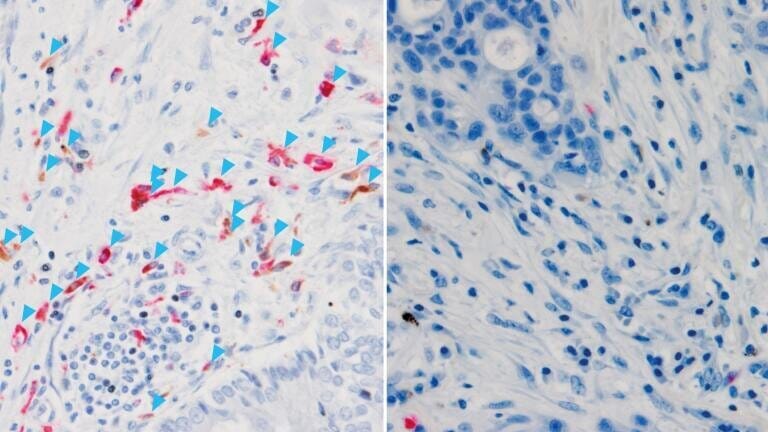
The team also analysed tumour samples from lung cancer patients which showed that those with higher C3 levels in the tissue surrounding cancer cells had better treatment outcomes and survival rates. Around half responded to treatment compared with none among patients with lower C3 levels. Once again, serum blood C3 levels made no measurable difference.
The researchers next plan to carry out experiments to boost local C3 levels and to establish the optimal timing for treatment. They believe that understanding how this ancient protein functions locally could also shed light on other biological processes, including wound healing and the management of inflammation.
For further reading please visit: 10.1038/s41467-026-75542-3
ILM 51.6 Sept 2026



 Product directory



















,-photo-Karin-Allander.jpg)





.jpg)
