Research news
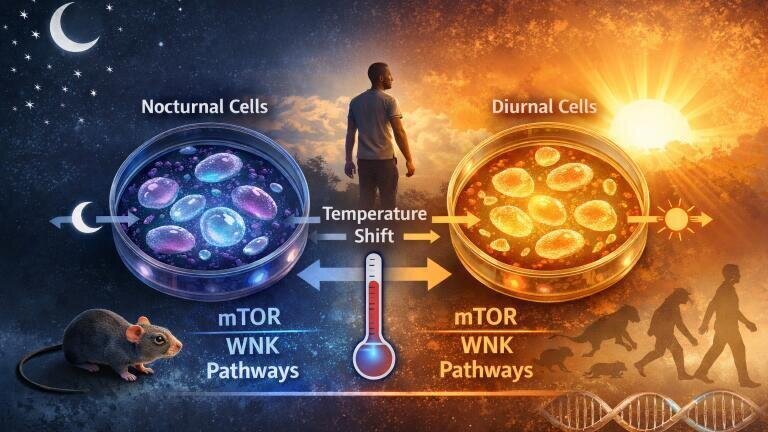
Why are humans active during the day when many mammals thrive at night? New research [1] published in Science suggests the answer lies deep within our cells.
Early mammals were nocturnal, avoiding daytime predators in a dinosaur-dominated world. Yet several lineages - including our own - later evolved to become active in daylight. This shift has long puzzled scientists because the brain’s central circadian clock appears to function similarly in both nocturnal and diurnal species.
The new study, led by Andrew Beale and John O’Neill at the MRC Laboratory of Molecular Biology, points to a different explanation. Rather than differences in brain circuitry, the key appears to be how individual cells respond to subtle environmental changes.
Across a 24-hour cycle, small fluctuations in body temperature and internal conditions influence chemical reactions inside cells. These cues alter fundamental processes such as protein production and modification - mechanisms that help determine whether a cell aligns itself with ‘day’ or ‘night’.
When the team compared cells from diurnal mammals (including humans) with those from nocturnal mammals such as mice, they found striking contrasts. Exposing the cells to daily temperature cycles caused their internal clocks to shift in opposite directions, mirroring each species’ natural activity pattern.
Two major signalling pathways - mTOR (mechanistic Target of Rapamycin) and WNK (With-no-lysine kinase) - were central to this divergence. These pathways regulate nutrient sensing and core biochemical functions. Human and mouse cells responded differently to temperature-driven changes in these systems, particularly in how they controlled protein synthesis.
Evolutionary analysis provided further insight. Genes within the mTOR and WNK networks appear to have evolved unusually rapidly in diurnal mammals, suggesting that the transition from night to day activity required genetic fine-tuning of fundamental cellular machinery.
To test whether these pathways could influence behaviour directly, researchers gently reduced mTOR activity in nocturnal mice using dietary interventions. The result was a measurable shift toward more daytime activity - effectively nudging the animals toward a more diurnal pattern.
The findings reveal that the nocturnal–diurnal divide may hinge on subtle cellular sensitivity to environmental rhythms rather than wholesale rewiring of the brain. They also raise broader questions about how mammals might adjust their activity patterns in response to climate change, as rising temperatures alter the environmental cues that cells rely upon.
“Understanding why humans are diurnal while many other mammals are not shines new light on our circadian rhythm, a fundamental part of our biology that shapes long-term health,” said John O’Neill. “Our findings show that small differences in how cells respond to daily environmental changes can ultimately determine when an animal is active.”
By uncovering a cellular ‘day–night switch’, the study provides a new perspective on circadian biology - and on why humans greet the sunrise while many of our mammalian relatives wait for dusk.
This work was funded by UKRI MRC, UKRI Future Leaders Fellowship, the Wellcome Trust and the Royal Society.
More information online
ILM 51.6 Sept 2026



 Product directory


















,-photo-Karin-Allander.jpg)





.jpg)

.jpg)