Research news
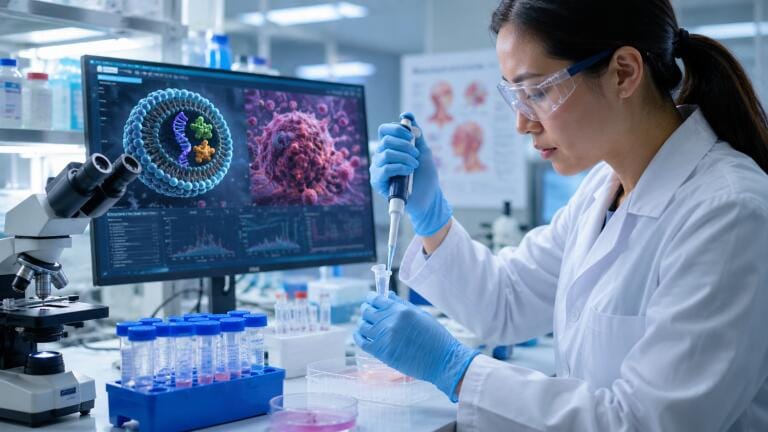
A University of Pennsylvania research team has developed a lipid nanoparticle platform that delivers two cancer-fighting therapies together, and has shown in preclinical models that the approach can reduce tumour burden and extend survival in oral squamous cell carcinoma
Oral squamous cell carcinoma (OSCC) is the most common form of head and neck cancer, and it remains difficult to treat with the five-year survival rate standing at approximately 50 per cent. Standard treatments such as ablative surgery and radiation often leave patients with permanent disfigurement or profound, lifelong impairment of essential functions, including speech and swallowing.
A multidisciplinary team of researchers at the University of Pennsylvania (Penn), Philadelphia, USA, has now developed a platform – based on lipid nanoparticles – that delivers a combination of cancer-fighting therapies to treat OSCC, including a treatment based on mRNA. The team was led by Dr. Michael Mitchell of the School of Engineering and Applied Sciences and Dr. Anh D. Le of the School of Dental Medicine, where she is the ‘Norman Vine Endowed Professor of Oral Rehabilitation’.
“mRNA lipid nanoparticles are a potentially promising technology to treat oral cancer, since tumours are accessible locally and can also be leveraged to generate a systemic immune response that targets metastatic tumours.
“However, tumour cells can be difficult to target [for delivery of] mRNA … so we designed a novel LNP delivery system for … oral cancer cells,” said Mitchell, who is the ‘Hibbert Professor of Bioengineering’ and leads the group developing lipid nanoparticle delivery systems at the Institute for RNA Innovation within Penn.
Le said the versatility of the platform meant it had the potential to benefit far more patients than traditional single-agent therapies: “opening the door to a broader, more effective class of treatments”.
More than 70 per cent of OSCC cases involve mutations in p53 – a common tumour suppressor protein – and the mRNA component of the platform is designed to restore its function. It is paired with ciclopirox, an antifungal drug approved by the US Food and Drug Administration that has also demonstrated anti-cancer and immunotherapy activity. Because both therapies require a delivery carrier, the team encapsulated them together in a single LNP formulation.
“Together, these two therapies act simultaneously through multiple mechanisms, directly killing cancer cells while reprogramming the immune system to target them instead of protecting them,” said Dr. Marshall Padilla, first author of the study and a former postdoctoral fellow in the Department of Bioengineering and the Center for Innovation & Precision Dentistry.
“The potential shift is from one-size-fits-all monotherapy toward a single, tunable delivery vehicle that works even when one of its two drugs fails, which matters because oral tumours vary enormously from patient to patient,” he added.
The team found that both p53 and ciclopirox have innate chemotherapeutic properties and, in combination, can diminish the immunosuppressive tumour microenvironment.
“In aggressive, p53-therapy-resistant [preclinical] cancer models, this novel LNP platform significantly reduces tumour burden and extends survival,” said Le.
Some aspects of the platform’s biology, however, have yet to be fully explained.
“The mechanism of how ciclopirox and p53 reprogram tumour-associated macrophages isn’t fully worked out. The paper points to a plausible pathway but flags that it needs to be confirmed,” said Padilla.
Future work will aim to refine the nanoparticle design for greater precision, to expand the range of therapeutic payloads beyond p53 and ciclopirox, and to explore different delivery routes. The team also intends to test the platform in more complex preclinical models that better reflect the genetic diversity of real patient tumours, a variability that has historically ‘sunk’ p53 therapies, according to Padilla.
“This work opens the door to an entirely new class of customisable nanotherapies for oral cancer,” said Le.
“This breakthrough was only possible because Penn’s deeply collaborative culture brings engineers, clinicians and scientists into the same space – often tackling the same unmet clinical need – creating the kind of cross-disciplinary momentum that enables advances like this,” she concluded.
For further reading please visit: 10.1002/adma.73721
ILM 51.6 Sept 2026



 Product directory



















,-photo-Karin-Allander.jpg)







.jpg)
