Research news
Researchers have developed an experimental compound – CS18 – that blocks a central regulatory protein and weakens several of the defences cancer cells rely on for survival
Researchers at Baylor College of Medicine, Houston, Texas, USA, have developed an experimental drug that disrupts cancer cells’ ability to survive treatment by blocking one of the central proteins they depend on to give them resistance for further therapy. The compound – CS18 – has shown promise across several cancer types in laboratory and animal studies.
“Therapeutic resistance is a main obstacle to achieving effective and durable cancer treatments,” said Dr Weei-Chin Lin, corresponding author of the study and professor of medicine, haematology and oncology, and of molecular and cellular biology at Baylor.
“While some therapies are effective at the beginning, many patients eventually relapse because cancer cells can activate compensatory and convergent biological pathways that allow them to overcome the toxic effects of therapy… promoting survival,” he said.
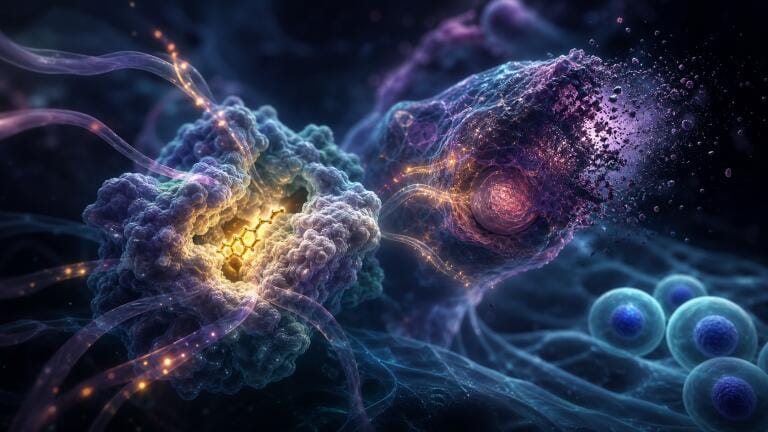
The researchers set out to design a drug able to target a single regulatory protein capable of controlling several cancer-driving pathways at once, rather than pursuing separate treatments for each pathway individually. Their target was topoisomerase IIβ-binding protein 1 (TopBP1) which the team describe as a molecular ‘switchboard’ governing multiple processes linked to cancer growth and survival. The aim was to establish whether disrupting this single hub could deliver a durable treatment response and help to overcome resistance.
“Of all the biological switches on TopBP1, [the] switch BRCT7/8 interacts with several key regulators of cancer growth – including Myc-interacting zinc finger protein 1(MIZ1) – a suppressor of cancer driver MYC; mutant p53.
“This can acquire cancer-promoting functions and [enable the proteins] polo-like kinase 1 (PLK1) and protein phosphatase 2A (CIP2A) … [which] help cancer cells survive and divide,” said Lin, a member of Baylor’s ‘Dan L Duncan’ Comprehensive Cancer Center.
“All together, these diverse roles position TopBP1-BRCT7/8 as a promising target for intervention,” he added.
BRCT7/8 refers to two of several BRCA1 carboxy-terminal (BRCT) domains within TopBP1, a region of the protein that acts as a docking site for other regulatory proteins. Among the partners it engages are MIZ1, PLK1 and the cancerous inhibitor CIP2A, together with the tumour-suppressor protein p53 and the growth-promoting protein MYC.
The research team screened thousands of chemical compounds using computational modelling and laboratory testing to identify molecules able to bind to the BRCT7/8 switch and block its cancer-promoting activity. This process led them to a compound named 3B6, which they went on to modify and test in numerous versions before arriving at CS18, the most effective candidate to emerge from the programme.
“When CS18 binds to BRCT7/8, the cancer-promoting activities of MYC and mutant p53 decreased, proteins involved in DNA repair became less active and cancer cells were more likely to die,” Lin said.
“In addition, CS18 increased the activity of genes that stop uncontrolled cancer growth. Altogether, CS18 appears to reduce several of the defences that help cancer cells survive therapy,” he said.
The team observed these effects in five cancer cell types:
The drug proved less toxic to non-cancerous cells in the same tests. When combined with cancer drugs already in clinical use, including poly(ADP-ribose) polymerase (PARP) inhibitors and osimertinib, CS18 killed cancer cells more effectively than either drug used on its own.
“In the case of lung cancer cells that were already resistant to osimertinib, adding CS18 restored the cells’ sensitivity to osimertinib, increasing cancer cell death,” Lin said.
“We observed a significant reduction of tumour growth in animal models with no major weight loss or other signs of toxicity,” he explained.
The researchers have proposed CS18 as a candidate for further development, potentially as part of combination treatments designed to prevent or overcome resistance to existing cancer drugs.
For further reading please visit: 10.1126/sciadv.aeg1996
ILM 51.6 Sept 2026



 Product directory



















,-photo-Karin-Allander.jpg)







.jpg)
