Research news
Researchers at the University of Birmingham have developed a vibrational exfoliation technique that enables scalable, room-temperature production of graphene and other 2D materials, offering a cleaner and more efficient alternative to conventional manufacturing methods.
The approach uses high-intensity mechanical vibrations to separate atomically thin layers from bulk materials, producing nanosheets of conductors, semiconductors and insulators – the fundamental building blocks of modern electronic devices. The work [1], led by scientists in the Department of Mechanical Engineering, is published in the journal Small.
The method increases production rates up to ten times compared with widely used techniques, while avoiding the use of toxic solvents.
Dr Jason Stafford, who led the research, said the technique addresses long-standing bottlenecks in scalable 2D material production while supporting more sustainable manufacturing routes.
2D materials consist of only a few atomic layers and exhibit unique electronic, thermal and mechanical properties compared with bulk materials, making them attractive for next-generation electronics, energy storage and sensor applications.
However, current production methods remain limited in scalability. Techniques such as shear mixing and sonication operate at low material concentrations, resulting in low throughput and high solvent waste. Ball milling can achieve higher yields but is associated with long processing times, contamination risks and structural defects.
Graphene in particular has proven difficult to manufacture at scale due to high production costs, variable quality and energy-intensive processes.
The vibrational exfoliation method addresses these challenges by applying mechanical energy to peel and split layered materials into nanosheets. The team demonstrated its effectiveness for graphene and other 2D materials, including hexagonal boron nitride and transition metal dichalcogenides such as molybdenum disulfide and tungsten disulfide.
The process uses a liquid medium but can be carried out using water and tannic acid, avoiding more hazardous solvents used in alternative methods.
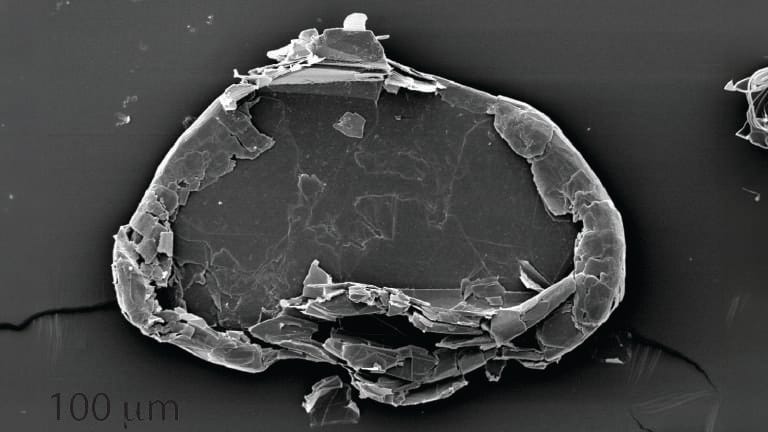
Microscopy and computational modelling show vibration induces edge folding in graphite particles, followed by progressive splitting and peeling into thinner layers, ultimately forming atomically thin graphene sheets. The method also operates at higher material concentrations than conventional techniques, significantly improving production rates, with early structural changes observed within minutes.
Analysis confirmed the resulting graphene is free from detectable structural defects.
The researchers are now seeking industrial partners to support further development and commercialisation of the technology.
More information online
ILM 51.6 Sept 2026



 Product directory




















,-photo-Karin-Allander.jpg)








.jpg)
