Research news
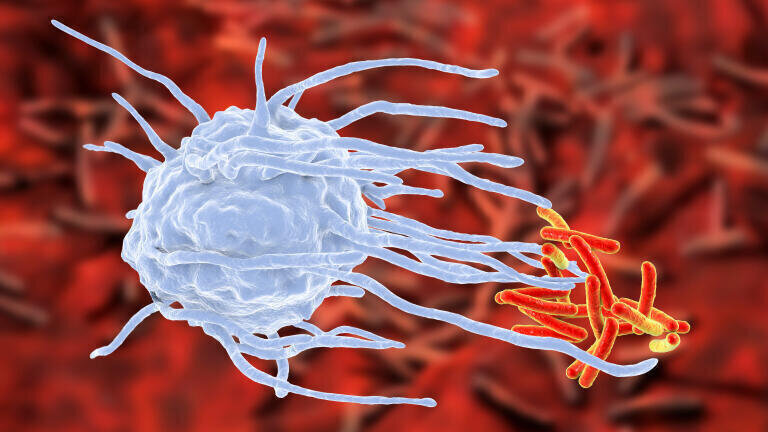
Tuberculosis (TB) remains one of the deadliest infectious diseases, claiming 1.5 million lives each year. Now, researchers have uncovered a surprising trick that helps explain its success: the bacterium behind TB, Mycobacterium tuberculosis (MTB), can hijack part of the immune system normally meant to protect us.
An international team co-led by the University of Exeter has found that MTB exploits a receptor called Dectin-1, which usually helps the body fight fungal infections, to survive and replicate inside immune cells. Published in Science Immunology [1], the study reveals that without Dectin-1, both human and mouse cells are far better able to control infection. Mice lacking the receptor were markedly more resistant to MTB.
“Our discovery shows that TB turns a key part of our immune defence to its own advantage,” said Dr Max Gutierrez, Francis Crick Institute. “Understanding this mechanism is a critical step toward explaining why TB is so effective in humans and animals.”
The researchers also identified a unique bacterial molecule, alpha-glucan, which targets Dectin-1 to trigger immune responses that inadvertently help MTB survive. “It’s counterintuitive,” explained Professor Sho Yamasaki, Osaka University. “A receptor designed to protect us actually promotes bacterial survival in this case.”
The findings could have far-reaching implications. Professor Gordon Brown, University of Exeter, noted: “This opens exciting possibilities - for example, modifying Dectin-1 in cattle could make them less susceptible to TB.”
The study represents a major step forward in understanding TB pathogenesis and may guide the development of new preventive or therapeutic strategies.
More information online
ILM 51.6 Sept 2026




 Product directory




















,-photo-Karin-Allander.jpg)