Research news
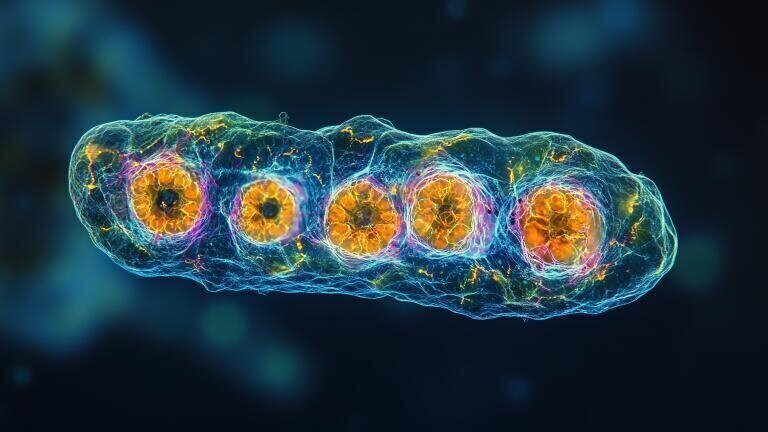
Researchers from The University of Manchester have discovered new details about how cells divide in living organisms, overturning the traditional view taught in schools for over 100 years.
In a Wellcome-funded study [1] published in Science, the team shows that the commonly taught idea - that cells become spherical before splitting evenly into two identical daughter cells - doesn’t hold true for many cells in the body.
Instead, they found that many dividing cells don’t round up, leading to asymmetric division where daughter cells differ in size and function. This process plays a key role in generating the diverse cell types needed for tissues and organs.
The researchers demonstrated that a parent cell’s shape before division influences whether it rounds up and whether its daughters are symmetrical. Shorter, wider cells tend to round and divide evenly, while longer, thinner cells divide asymmetrically without rounding.
The team used real-time imaging in transparent zebrafish embryos to observe this behaviour in developing blood vessels, noting that fast-moving ‘tip’ cells divide asymmetrically to produce daughter cells with distinct roles.
They also applied micropatterning - a technique that controls cell shape by designing protein-coated surfaces - to human cells, confirming the link between cell shape and division symmetry.
These findings have broad implications for understanding diseases like cancer, where asymmetric division may promote tumour growth and metastasis, and for regenerative medicine, where controlling cell division could improve tissue repair strategies.
More information online
1. Interphase cell morphology defines the mode, symmetry, and outcome of mitosis, published in Science
ILM 51.6 Sept 2026



 Product directory


















,-photo-Karin-Allander.jpg)






.jpg)
