Research news
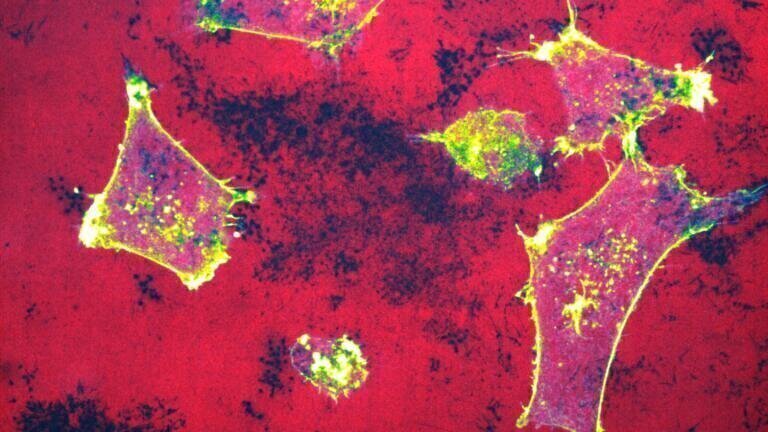
Researchers at the University of Turku, Finland, have created an innovative fluorescent probe that visualises the complex signalling events driving breast cancer cell movement during metastasis. This breakthrough tool, named Illusia, allows scientists to observe previously invisible cellular signals in real time, opening new avenues to limit cancer dissemination.
Led by Professor Johanna Ivaska and Dr James Conway, the team focused on understanding how breast cancer cells transition from a pre-malignant state (ductal carcinoma in situ, DCIS) to invasive ductal carcinoma (IDC), a progression associated with poorer patient outcomes and incurable metastatic disease.
“Cell signalling controls vital processes such as growth and movement, but tracking these signals inside living cells has been a major challenge,” said Dr Conway. “Illusia is designed to illuminate these dynamic signals, enabling us to see how cancer cells respond and migrate.”
Their research [1] identified the protein phosphatase Shp2 as a crucial regulator that controls how cancer cells interact with their surroundings during invasion. Notably, drugs already in clinical trials targeting Shp2 in other cancers show promise to also block breast cancer spread, providing hope for new treatment strategies.
“Metastasis relies on cancer cells moving from the primary tumour to distant organs, yet no current therapies effectively block this migration,” explained Professor Ivaska. “Our findings highlight a potential therapeutic target that could change that.”
Beyond breast cancer, this discovery offers insights into the broader mechanisms of cancer cell invasion across solid tumours.
Illusia’s name was inspired by a Finnish folklore about a fairy from the rainbow, reflecting the colourful signals the probe reveals and the team’s quest for better cancer treatments.
Professor Johanna Ivaska leads a research group within InFLAMES Flagship, a collaborative initiative between the University of Turku and Åbo Akademi University in Finland. The programme focuses on discovering new drug targets and advancing personalised therapies through partnerships with biotechnology and pharmaceutical companies. InFLAMES is supported by the Research Council of Finland as part of its flagship programme.
More information online
1. Dynamic regulation of integrin β1 phosphorylation supports invasion of breast cancer cells published in Nature Cell Biology
ILM 51.6 Sept 2026



 Product directory
















,-photo-Karin-Allander.jpg)







.jpg)
