
Research news
Scientists at Vilnius University’s Life Sciences Centre (VU LSC), working with colleagues from the Weizmann Institute of Science in Israel and Harvard Medical School in the USA, have uncovered a unique bacterial immune signal with the help of high-resolution structural techniques. The discovery, led by Dr Giedrė Tamulaitienė’s research group at VU LSC, has been published in Nature [1].
The team investigated the Thoeris II defence system, which enables bacteria to detect viral infections and trigger a protective, self-destructive response. Central to this process is a newly identified small molecule - histidine-ADP-ribose (His-ADPR) - composed of an amino acid and a nucleotide, unlike previously known signals that only involve nucleotides.
To understand how this signal is detected and acted upon, the VU LSC researchers used X-ray crystallography to determine the structure of the effector protein bound to His-ADPR. This structural analysis revealed how the signal activates the effector at the bacterial membrane, leading to cell death and prevention of viral spread. Meanwhile, collaborators at the Weizmann Institute confirmed that the molecule is produced in response to infection, and researchers at Harvard Medical School resolved the structure of a viral ‘sponge’ protein that neutralises the signal to evade bacterial defence.
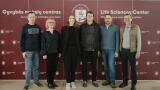
The study involved contributions from multiple research teams: PhD student Džiugas Sabonis led the work at VU LSC, supported by Deividas Vilutičius, Audronė Rukšėnaitė, Dr Arūnas Šilanskas, and Dr Mindaugas Zaremba. The Israeli group was led by Professor Rotem Sorek, and the US collaborators by Professor Philip Kranzusch.
By combining crystallographic techniques and molecular microbiology, the team has opened new avenues for understanding bacterial immunity and the structural basis of host–pathogen interactions.
More information online
1. TIR domains produce histidine-ADPR as an immune signal in bacteria published in Nature
ILM 51.6 Sept 2026



 Product directory


















,-photo-Karin-Allander.jpg)







.jpg)
