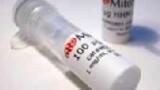
A new highly sensitive and robust nucleic acid gel stain has been introduced by Cambridge Bioscience. GelRed?, developed by Biotium, is a red fluorescent nucleic acid dye designed for both precast and post gel staining. Its combination of low toxicity, extraordinary stability, versatility and sensitivity (even for low molecular weight DNA fragments) sets it apart from all other nucleic acid stains on the market.
GelRed offers an excellent alternative to the widely used ethidium bromide (EB) stain, which is not only highly mutagenic but often requires a destaining step to reduce background fluorescence. GelRed is highly stable so, when used as a precast gel stain, it can be microwaved with agarose or subjected to other heating procedures commonly used in gel preparation. Importantly, gels can also be safely and conveniently stored for later use without compromising performance.
The GelRed dye has a major excitation peak at around 300 nm and a red emission at around 595 nm meaning it can be optimally excited with a standard 300 nm UV transilluminator while its fluorescence emission is completely compatible with a standard EB filter or SYBR filter.






 Product directory