Microscopy & microtechniques
Published over 13 years ago. See the latest and most current information on Microscopy & microtechniques.
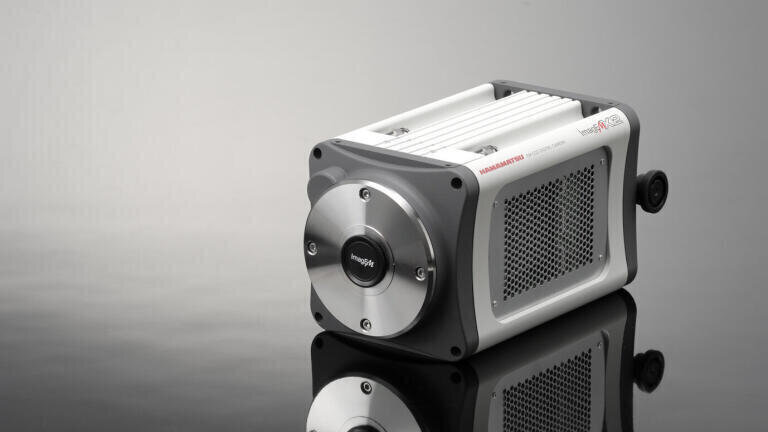
Hamamatsu Photonics has released the ImagEM X2, a new electron multiplying (EM) CCD camera with even faster speed than previous ImagEM cameras. The ImagEM X2, a completely redesigned camera featuring a back-thinned EM-CCD sensor, offers maximum speed and precision performance for low-light imaging.
The ImagEM X2 makes superfast exposures possible and has the sensitivity to provide visually pleasing and quantitatively meaningful images in a photon-starved environment. It delivers 70 frames/s at the full resolution of 512 x 512 pixels with a high signal-to-noise ratio, enabling quantitative high-speed, low-light imaging. When binning or a region of interest is selected, this new camera produces images at even higher frame rates (up to 1076 frames/s).
Additional features allow for optimised camera triggering and streamlined connectivity through IEEE 1394b. The ImagEM X2 also has improved overall signal-to-noise ratio, increased non-EM dynamic range, and built-in EM gain measurement and calibration functions. It also features a software-controllable shutter that prevents EM gain degradation and image lag. To prevent EM gain degradation, the shutter is closed when the built-in EM gain protection feature is enabled. In addition, closing the shutter when a user replaces a lens, for example, can prevent image lag.
ILM 51.6 Sept 2026





 Product directory


.jpg)