Microscopy & microtechniques
Published over 11 years ago. See the latest and most current information on Microscopy & microtechniques.
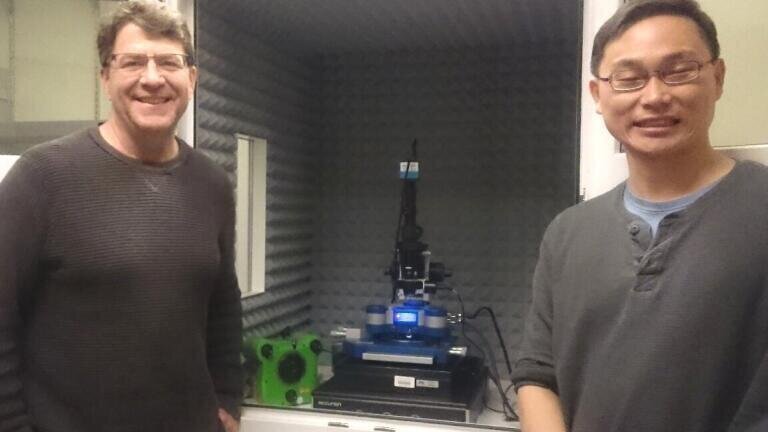
JPK Instruments reports on the use of their NanoWizard®3a AFM and ForceRobot systems by the Messersmith Research Group at UC Berkeley to study biologically inspired polymer adhesives.
Dr Phillip Messersmith is the Class of 1941 Professor in the Departments of Bioengineering and Materials Science and Engineering at the University of California at Berkeley. His research group is interested in understanding structure-processing- property relationships of materials in biological systems, and in using this information to inform the design, synthesis and application of biologically inspired synthetic materials used in a variety of practical applications. Current projects include molecular mechanochemical studies of biological wet adhesives, the design of biomimetic wet adhesive polymers and polymer composites, the control of biointerfacial phenomena in nanosystems and in antifouling surface coatings, and the development of novel biomaterials for regenerative medicine.
One of the Group members, Dr Yang Wei, describes how they started to use JPK's range of SPM systems in a project about biologically inspired polymer adhesives. The goal is to understand wet biological adhesion and then to develop biologically inspired surgical adhesives for use in medicine and dentistry. Measuring forces of interaction between proteins and polymers and surfaces are crucial to understanding how organisms such as the mussel are capable of attaching to underwater surfaces. To achieve these measurements, atomic force microscopy has been applied to provide a very convenient way of performing biophysical studies of mussel adhesive proteins. In this work, multiple force-extension curves have been measured. Typical of this work, a single polymer chain containing the DOPA functional group adapted from mussel adhesive proteins is pulled from a surface using an AFM tip, (see diagram). This experiment was then automated with the use of JPK's ForceRobot®300 system.
Speaking of its performance, Dr Wei said: “I specifically enjoy using this fully automated force spectroscope with automated laser and detector alignment which provides high quality in terms of maximum sum values and lowest Z-sensor noise level in force data output.”
ILM 51.6 Sept 2026




 Product directory