News
Published over 10 years ago. See the latest and most current information on News.
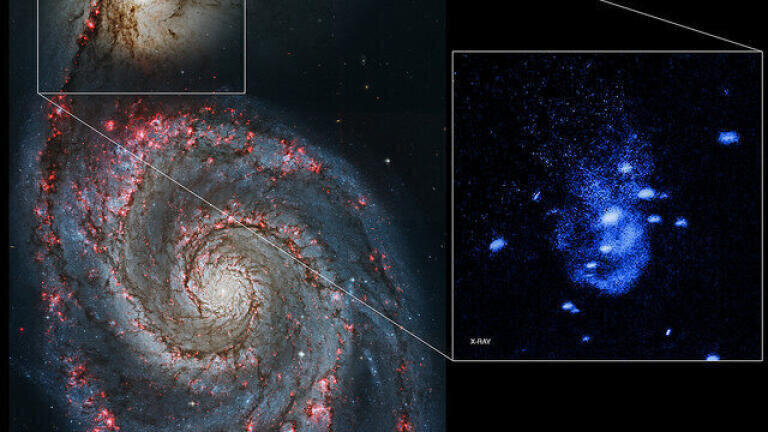
Babies and adults alike love to indulge in the occasional belch, but it’s not every day that a release of gas is recorded on a cosmic scale. Thanks to ultra-advanced x-ray images from NASA’s Chandra space telescope, astronomers have recorded two massive waves of gas being ‘burped’ by NGC 5195, a black hole located in the heart of a neighbouring galaxy.
The ribbons of hot gas appear to be pushing swathes of cooler gas forward as they escape from the depths of NGC 5195, the pint sized sibling of the immense "Whirlpool Galaxy" located 26 million light years away. As it’s so far from home, NGC 5195 has been categorised as one of the closest belching black holes blasting gas towards Earth.
The findings were revealed at the latest 227th meeting of the American Astronomical Society (AAS), with space scientists describing the phenomenon as a theatrical example of “feedback” between a host galaxy and a supermassive black hole.
Marie Machacek, a co-author of the study from the Harvard-Smithsonian Center for Astrophysics (CFA) and expert in ‘burping’ black holes theorises that “Feedback keeps galaxies from becoming too large.” She also asserts that the release of gas is also responsible for the formation of some stars, demonstrating how “Black holes can create, not just destroy."
This creator status gives black holes a fresh new reputation, as they’re generally notorious for guzzling gas and stars. The latest images from the Chandra space telescope suggest otherwise, capturing two arcs of material that the NASA team has likened to a burp.
So what causes the outbursts. According to astronomers, NGC 5195 likely gorged on gas when interacting with its Whirlpool Galaxy neighbour. As matter was consumed it triggered the release of huge amounts of energy, leading to the outburst of hot, x-ray emitting waves that actively push out cooler hydrogen gas.
Eric Schlegel, leader of the ‘burping’ black hole study conducted at San Antonio’s University of Texas described the event as “The best example of snowplough material I've ever seen.”
As well as influencing conditions in outer space, gas is also an important part of life on planet Earth. ‘Determination of Biomarkers in Petroleum by Multidimensional Gas Chromatography: Fundamentals, Applications, and Future Perspectives’ explains its role in the oil industry, and how two-dimensional gas chromatography has improved characterisation of potential biomarkers by dampening co-elution and increasing the signal-to-noise ratio during chromatographic analyses.
Image via Flickr Creative Commons. Photo credits: NASA's Marshall Space Flight Center
Lab Asia 33.4 - August 2026

 Product directory