News
Published over 9 years ago. See the latest and most current information on News.
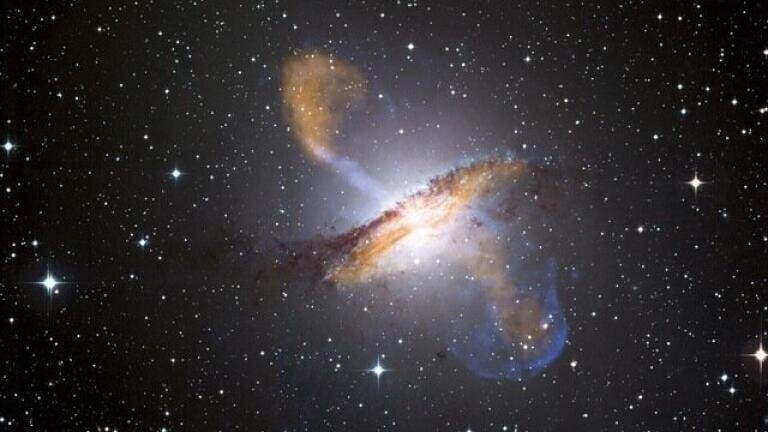
Everything around us is made up of matter. It’s the substance that makes up any physical object – anything with mass. That seems pretty straightforward, right? But you may have heard scientists and astronomers referring to ‘dark matter’. What is this mysterious concept? Is it just a type of matter, or something completely different?
Whilst everything we encounter is made up of matter, the same cannot be said for the universe. It’s thought that around 27% of the observable universe is made up of dark matter, with a further 68% consisting of dark energy. The stars and planets we can see and observe are actually only a small fraction of what’s out there. The name ‘dark’ matter is quite literal in its meaning. Dark matter doesn’t emit or interact with light, or any other forms of electromagnetic radiation. It’s practically invisible in terms of the electromagnetic spectrum.
Because of its lack of light and electromagnetic radiation, it’s a bit tricky for scientists to observe and research dark matter. It cannot be detected by any form of radiation. Visible light, X-rays, and even gamma rays are all useless for researching dark matter.
So far, they can only predict its attributes and qualities based on its gravitational effects – the way it interacts with and affects regular matter. Observing the motion of visible matter can reveal the effect dark matter is having on it. Essentially, it’s like observing an invisible man based on the effect he has when he pushes the visible people surrounding him.
A specific case of this was in the 1950s, when a team of astronomers were examining spiral galaxies. They hypothesised that – based on the matter they could observe – material in the centre would move faster than material on the edges. Their findings revealed something a bit different. The stars were travelling at the same velocity on both the inner and outer parts of the galaxies. Of course, this meant that there must be more mass there than they could actually see.
It’s hard to conceptualise this dark, unobservable substance because we live in a world that’s full of light. Whether it’s bacteria, plants, wild animals or human beings – our planet is essentially powered by light. Explore the fascinating story of light and life in Bright Lights, Big Science: The physical phenomenon that has helped to shape human history and open up our world.
ILM Guide 2026/27

 Product directory