News
Published over 12 years ago. See the latest and most current information on News.
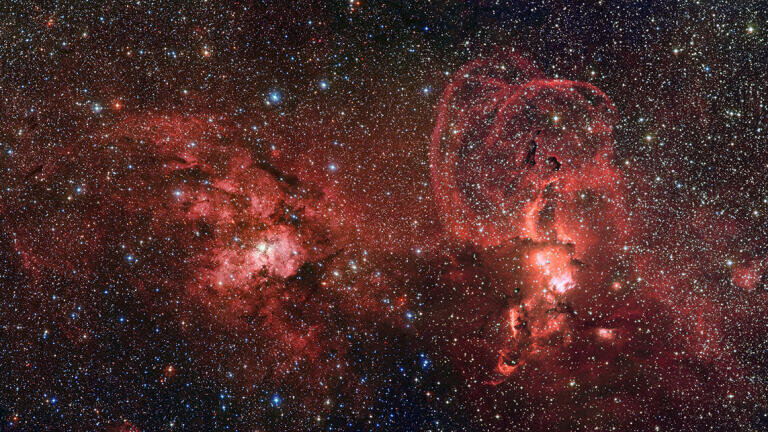
This remarkable image, captured by the Wide Field Imager at European Space Agency’s (ESO) La Silla Observatory in Chile, shows two dramatic star formation regions in the southern Milky Way.
The first of these star clusters, on the left, is 20,000 light-years away, in the Carina–Sagittarius spiral arm of the Milky Way galaxy. Known as NGC 3603, it has the highest concentration of massive stars that have been discovered in our galaxy so far. At the centre of the cluster lies a multiple star system, the stars within which have at least 20 times the mass of the Sun.
The second star formation region, on the right, is a collection of glowing gas clouds that lies only about half as far from Earth. Known as NGC 3576, it is notable for two huge curved objects resembling the curled horns of a ram. These are the result of stellar winds from the hot, young stars within the central regions of the nebula, which have blown the dust and gas outwards across a hundred light-years.
Two dark silhouetted areas, known as Bok globules, are also visible in this vast complex of nebulae. These black clouds offer potential sites for the future formation of new stars.
Both clusters were first observed by English astronomer, John Herschel, in 1834 during his three-year expedition to systematically survey the southern skies from near Cape Town.
ILM 51.6 Sept 2026





 Product directory


.jpg)