News
Published over 16 years ago. See the latest and most current information on News.
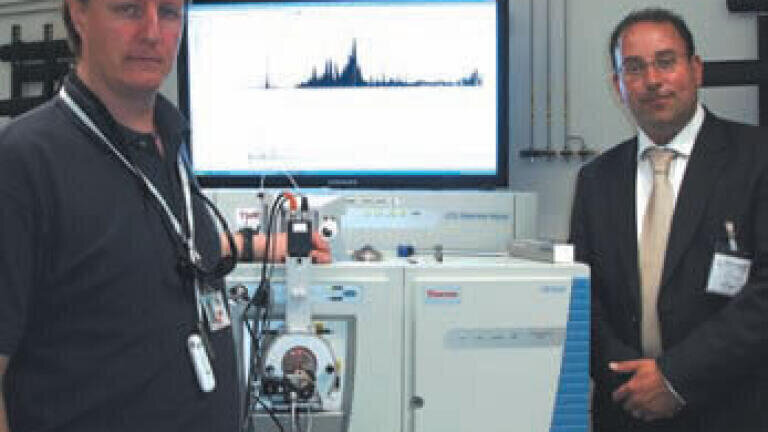
Thermo Fisher Scientific is supporting a team of scientists involved with the integrated network/biology initiative at The Institute of Cancer Research having equipped the institute’s new proteomics laboratory with a
workflow, including the Kingfisher Flex automated sample preparation system, the TSQ Vantage triple quadrupole and the UK’s first two LTQ Orbitrap Velos mass spectrometers.
"Typically, cancer research focuses on the function and behavior of individual genes or proteins," explains Dr Rune Linding, head of the cellular and molecular logic team at the ICR. "The ICR’s effort aims to assess how
networks of cancer cells interact with each other and surrounding tissues to metastasize, or spread, throughout the body. By modeling and simulating how cancer cells interact within the larger biological network, ICR researchers hope to achieve breakthroughs leading to new drugs or treatments that prevent metastasis - the process that claims the lives of about 90 percent of cancer patients."
Dr. Linding added that the new systems would enable researchers to study new aspects of cellular signaling networks and perform massive scale studies of the dynamics in these networks which he believed to understanding progression of cancer.
The chairman of the ICR’s section of cell and molecular biology Professor Chris Marshall, FRS, added, "Furthermore, we think that the integration of data from mass spectrometry analysis with other data, such as genetic
RNAi screens, will allow us to generate detailed models of processes such as invasion and metastasis. Such a detailed under - standing is important to start treating the signaling network as a whole rather than
individual nodes, an approach known as network medicine."
ILM 51.6 Sept 2026





 Product directory