

News
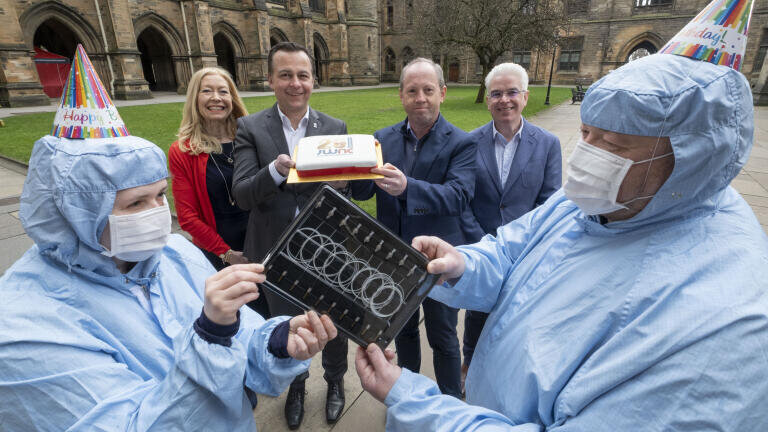
A leading UK nanofabrication facility that has helped shape the technology underpinning modern internet infrastructure is marking its 20th anniversary.
The University of Glasgow’s James Watt Nanofabrication Centre (JWNC) has spent two decades advancing nanoscale device development, supporting both academic research and global industry. Since its first test run in 2006, the £35 million facility has worked with nearly 200 high-tech companies and contributed to applications ranging from space-based sensing to high-speed communications.
Central to its success is expertise in electron-beam lithography, enabling the fabrication of structures at the nanometre scale. These capabilities have played a key role in the development of semiconductor lasers used in large-scale data centres, supporting faster fibre-optic communications worldwide.
Collaborations with industry partners, including work with Kelvin Nanotechnology, have helped translate early-stage research into commercial products, including photonic devices now deployed across global optical networks.
“Over the last 20 years, the centre has helped take research out of the lab and into real-world applications, supporting both fundamental science and commercial innovation,” said Professor Martin Weides, Director of the James Watt Nanofabrication Centre.
Beyond commercial impact, the centre has achieved multiple technical milestones, including record-breaking pattern resolution and alignment at the nanoscale. Devices fabricated at JWNC have been used in applications ranging from environmental monitoring to sensing on the International Space Station.
The facility also plays a major role in skills development, training more than 200 postgraduate students each year, many of whom now work across the global technology sector.
Looking ahead, plans are underway for a next-generation Critical Technologies Nanofabrication Facility, aimed at accelerating the transition from laboratory research to commercial deployment while strengthening UK capabilities in advanced manufacturing.
More information online
ILM 51.6 Sept 2026



 Product directory


























.jpg)
