Research news
Researchers at the University of Glasgow have developed a miniature implantable device designed to improve the precision of photodynamic therapy for bladder cancer by delivering light directly to tumour sites.
The work [1], published in Opto-Electronic Advances and supported by funding from UKRI’s Engineering and Physical Sciences Research Council (EPSRC), describes a flexible, wirelessly powered micro-LED system that can transmit light through tissue-like materials, offering a potential route to more targeted and less invasive cancer treatment.
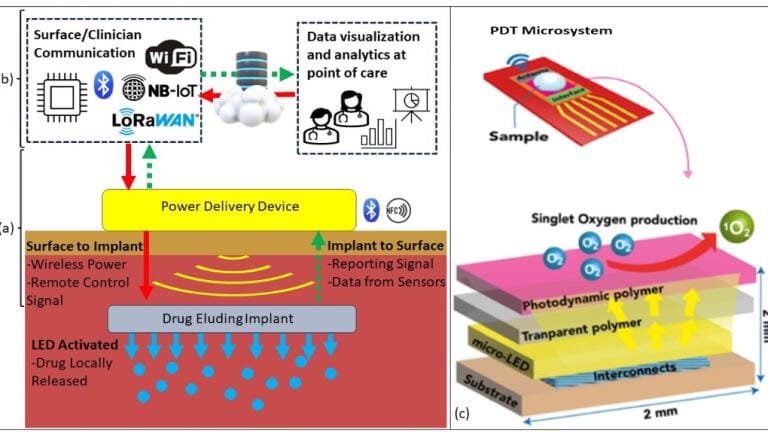
Photodynamic therapy uses light-sensitive drugs known as photosensitisers, which produce reactive oxygen species when activated by light to destroy cancer cells. While effective in some superficial cancers, its use in internal tumours is limited by poor light penetration through biological tissue, often requiring invasive procedures or external high-powered light sources.
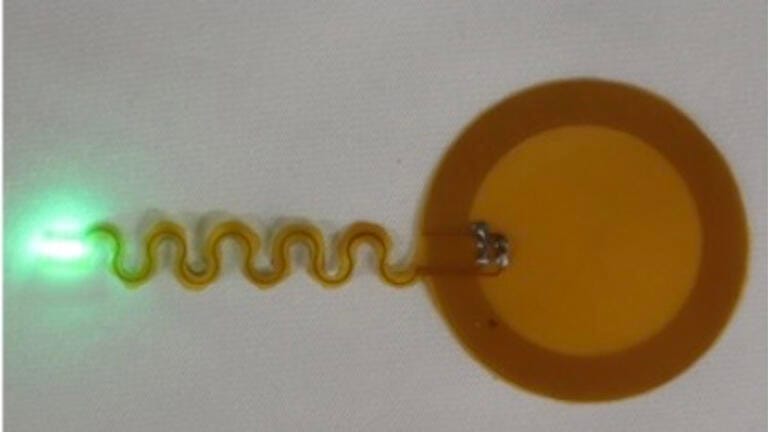
To address this, the team developed a disc-shaped implant containing four micro-LEDs mounted on a biocompatible polymer substrate. The device is powered wirelessly via resonant inductive coupling, removing the need for wired connections or external light delivery systems.
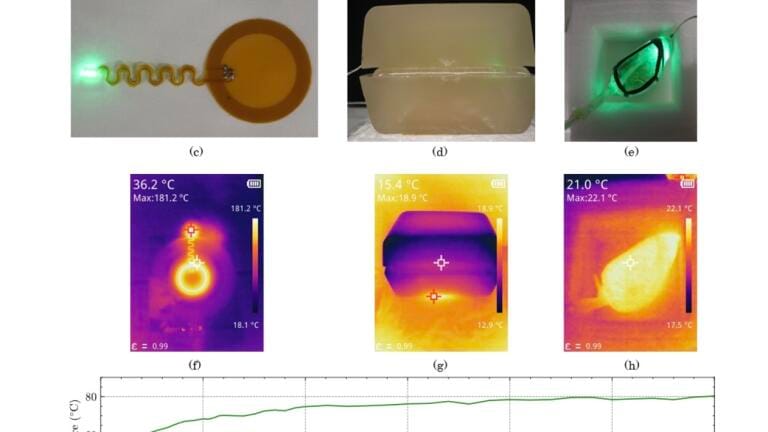
In laboratory experiments using tissue-mimicking materials, the system successfully delivered light through samples up to 50mm thick with minimal loss. The researchers also demonstrated that the device could activate a photosensitiser solution, triggering production of singlet oxygen — the reactive molecule responsible for destroying cancer cells in photodynamic therapy.
Dr Rolan Mansour, corresponding author from the University of Glasgow’s James Watt School of Engineering, said:“Given that photodynamic therapy has the potential for fewer side effects and could improve cancer treatment outcomes, our work is focused on improving its effectiveness by delivering light where it’s most needed, to the photosensitisers which tackle and kill cancer cells.”
Professor David Flynn, who led the EPSRC-funded PATIENT project, said the results highlight the potential of combining flexible bioelectronics, wireless power delivery and photonics to create minimally invasive cancer therapies with improved clinical outcomes.
The researchers say further work is needed before clinical application, but the results point toward a new class of implantable light-based medical devices that could improve the precision and accessibility of photodynamic therapy.
More information online
ILM 51.6 Sept 2026



 Product directory




















,-photo-Karin-Allander.jpg)








.jpg)
