Research news
Researchers working on gravitational wave observatories have developed a way for detectors to effectively ‘autotune’ themselves using signals from colliding black holes.
The international LIGO, Virgo and KAGRA (LVK) collaboration says the technique, known as astrophysical calibration, allows detectors to correct subtle distortions in their data using gravitational-wave signals themselves - similar to how music software such as Auto-Tune corrects pitch.
The approach could improve the accuracy of observations from some of the world’s most sensitive scientific instruments, helping researchers better locate and analyse events such as black hole mergers.
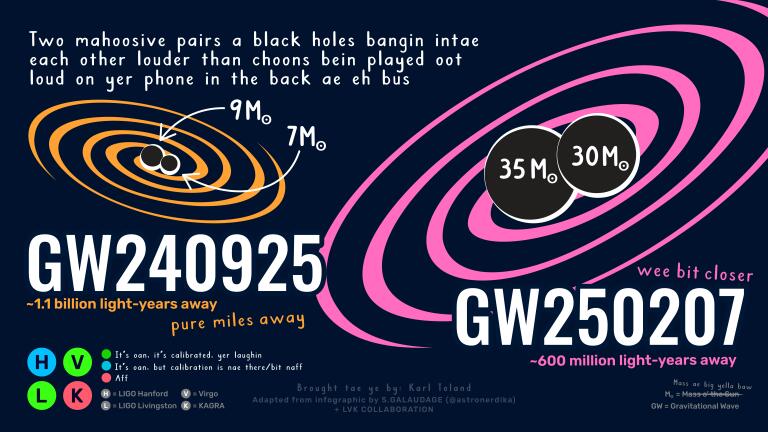
Scientists tested the method using two strong gravitational-wave signals detected in 2024 and 2025, during periods when one of the LIGO detectors in Washington State was not operating at peak performance.
By comparing observed signals with precise predictions from Einstein’s theory of general relativity, researchers were able to identify and correct calibration errors in the detector data, recovering information that may otherwise have been lost.
Dr Christopher Berry of the University of Glasgow’s Institute for Gravitational Research said: “Gravitational waves are ripples in spacetime that stretch and squeeze space. Our detectors turn those signals into distinctive chirps that reveal information about black holes, including their masses, distance and location.”
The researchers say the technique will help future observing runs produce more reliable results, even when detector conditions are less than ideal.
The study [1], accepted by Physical Review Letters, comes 10 years after the first detection of gravitational waves - a breakthrough that later earned the Nobel Prize in Physics.
More information online
ILM 51.6 Sept 2026



 Product directory


.jpg)
.jpg)















,-photo-Karin-Allander.jpg)




.jpg)
