Raman spectroscopy
A novel low-frequency Raman spectroscopy method has been developed which can detect subtle changes in the structure of porphyrin molecules – adaptations that are usually too small to be detected – by a research team led by Dr. Huang Qing of the Hefei Institutes of Physical Science at the Chinese Academy of Sciences, Xinhua, China.
Tiny, out-of-plane (OOP) deformations of metalloporphyrin molecules are important for the biological functions of enzymes. However, these deformations are so small and vary slightly between molecules, making them hard to detect with traditional methods.
Unlike techniques like X-ray diffraction or nuclear magnetic resonance, resonance Raman spectroscopy is better at identifying structural features in these molecules. However, the relationship between specific deformations and the shifts in Raman peak frequencies has been unclear due to the complexity of the molecular interactions and the difficulty of measuring low-frequency Raman signals.
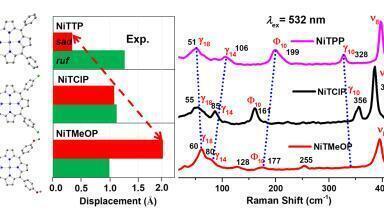
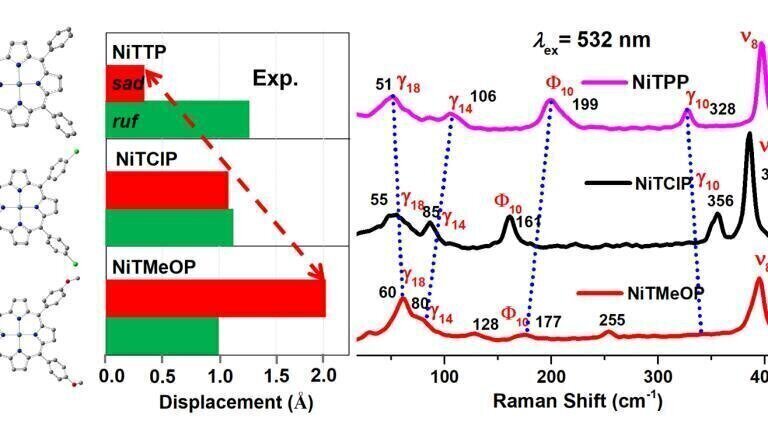
In this study, the team first employed nickel porphyrin as a model molecule and conducted density functional theory calculations to explore the correlation between two biologically relevant deformations – ruffling and saddling – and Raman spectral shifts. They then tested their approach on three different types of nickel porphyrins and successfully captured Raman spectra with extremely low frequencies – around 10 cm⁻¹ – revealing clear patterns.
The researchers found that all three porphyrins showed similar ruffling deformations, with only small differences in their saddling deformations. Most importantly, they discovered that the shift in a particular Raman peak – the γ18 peak – could be directly linked to the degree of saddling deformation in these molecules.
This relationship means that researchers can now use the γ18 peak as a reliable indicator for detecting subtle structural changes in porphyrins.
This study not only shows how low-frequency Raman shifts can detect OOP deformations in porphyrin molecules caused by environmental changes but also provides a useful tool to understand how these deformations affect their biological functions.
For further reading please visit: 10.1016/j.saa.2025.125750
ILM 51.6 Sept 2026



 Product directory


.jpg)
.jpg)