Raman spectroscopy
Scientists at Shanghai Jiao Tong University have developed a novel chaos-assisted computational spectrometer that achieves ultra-high resolution and broad operational bandwidth within a footprint smaller than a grain of sand, marking a major advance in on-chip optical sensing and portable spectroscopy
A research team at Shanghai Jiao Tong University in Shanghai, China – led by Professor Xuhan Guo and Professor Yikai Su – has reported a novel ultra-compact computational spectrometer that resolved the long-standing three-way trade-off among device footprint, spectral resolution and operational bandwidth.
The device achieved a broad operational bandwidth of approximately 100 nanometres alongside a high spectral resolution of 10 picometres, all within an exceptionally small footprint of 20 × 22 µm². This scale aligns with other nanomaterials-based computational spectrometers but with superior performance characteristics.
“In chaotic systems – [where] eventual behaviour is exponentially sensitive to small deviations [from the] initial condition – is usually avoided in most cases.
“However, for some specific scenarios, chaotic behaviour can be transformed into a dominant resource to efficiently achieve requirements, such as the application in computational spectrometer,” the researchers explained.
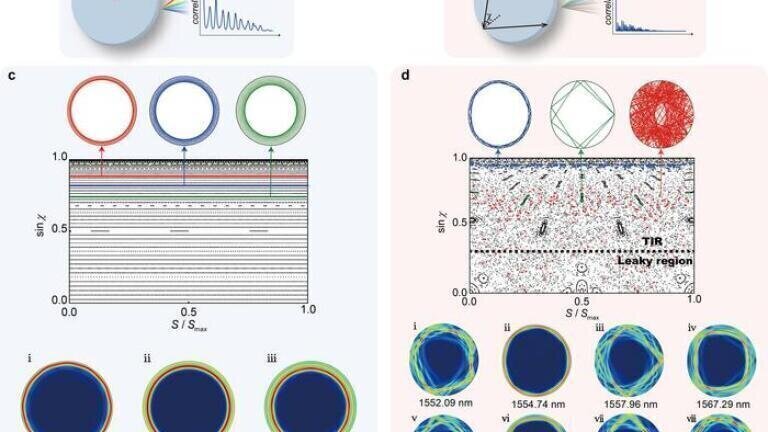
They designed a single chaotic cavity whose boundary has been smoothly deformed into a ‘Limaçon of Pascal’ shape to exploit chaotic spectral information. This shape is a type of mathematical curve belonging to the family of rational plane curves which were first studied by Étienne Pascal in the 17th century. The name limaçon derives from the French word for ‘snail’ so describing its characteristic spiral-like form (r = a + b cosθ). This configuration eliminated the periodicity typical of resonant cavities and produced a highly decorrelated response matrix with exceptional diversity.
“Employing this high-quality response matrix, we experimentally achieved ultra-high spectral resolution in a broadband operational bandwidth, attaining a record high of bandwidth-to-resolution ratio per footprint,” they said.
The on-chip device consumed only 16.5 milliwatts of power, less than half that of many current computational spectrometers, which typically require more than 30 milliwatts. The substitution of grating couplers with edge couplers substantially expanded the operational bandwidth to more than 300 nanometres. The researchers stated that their design could be adapted to other wavelength bands by modifying the dimensions of the chaotic cavity to suit different transparent windows in silicon or other material systems.
They further noted that the computational resources required by the chaos-assisted spectrometer could be supported by existing consumer mobile devices. This capability, they suggested, opens a practical route towards low-power, low-cost portable spectral sensing.
For further reading please visit: 10.1038/s41377-025-01984-x
ILM 51.6 Sept 2026



 Product directory


.jpg)
.jpg)