Laboratory products
Conventional GC-MS methods reach their limits in complex matrices and expanding compound lists. A DBDI-based ion source generates intact molecular ions instead of fragments, opening the door to simpler workflows, MS/MS confirmation, and spectral libraries shared with LC-MS.
Comprehensive pesticide residue analysis today typically means running two separate systems. Volatile, non-polar compounds are captured by gas chromatography with electron impact ionisation (GC-EI); polar, less volatile substances go through liquid chromatography with electrospray ionisation (LC-ESI). The split follows the ionisation chemistry more than the separation technique itself: hard EI ionisation requires analytes in the gas phase and produces characteristic fragment spectra, while gentle ESI ionisation works on dissolved analytes and yields intact molecular ions - with particularly high sensitivity for polar, easily protonated substances. Because real pesticide panels routinely span both compound classes, full coverage means running both platforms in parallel, with the corresponding overhead in instruments, method development, spectral libraries and training.
Within this two-platform model, GC-EI shows a specific weakness in complex matrices. Electron impact ionisation exposes analyte molecules to high-energy electrons; the molecular ion is destroyed, leaving a characteristic but heavily fragmented pattern of 10 to 20 peaks clustered in the low mass range. In clean matrices at sufficient concentration, this isn’t a problem. In real samples - food extracts, environmental matrices, complex agricultural material - these fragment ions crowd into an already dense low-mass window and compete with background matrix signals.
The result is more manual effort at the peak-identification stage and reduced selectivity near the regulatory Maximum Residue Limit (MRL). Regulations compound the issue: for many substances, at least two identification points are required. If the SIM (Selected Ion Monitoring)- signal isn’t unambiguous, a second measurement on an LC-MS platform becomes necessary - complete with fresh, often laboriously re-optimised sample preparation. For strongly non-polar or poorly protonatable analytes, even that fallback can fail, since these compounds simply won’t ionise under ESI conditions.
This is where a broad-coverage ion source comes in. Plasmion has commercialised this approach under the name SICRIT®, based on dielectric barrier discharge ionisation (DBDI): an alternating voltage generates a cold plasma. Analytes are drawn through this ring-shaped plasma by the vacuum of the atmospheric-pressure mass spectrometer. Because charge transfer occurs without direct contact between plasma and sample, the molecule stays largely intact. Instead of spreading signal across 10 to 20 fragment peaks the way EI does, the DBDI source concentrates it into one or two dominant ion species — predominantly [M+H]⁺ and [M]⁺. Since the source ionises both polar and non-polar compounds, and dedicated coupling modules let it run with either GC or LC separation, it covers nearly the entire analytical space of the two previously separate platforms.
That the ion source delivers intact molecular ions and works across both separation platforms is the technical foundation. The question that matters for lab adoption is whether sensitivity holds up for regulatory limits of detection (LODs), which need to reach or beat the EU standard threshold of 10 ppb - ideally without relying on targeted acquisition modes such as SIM or MRM.
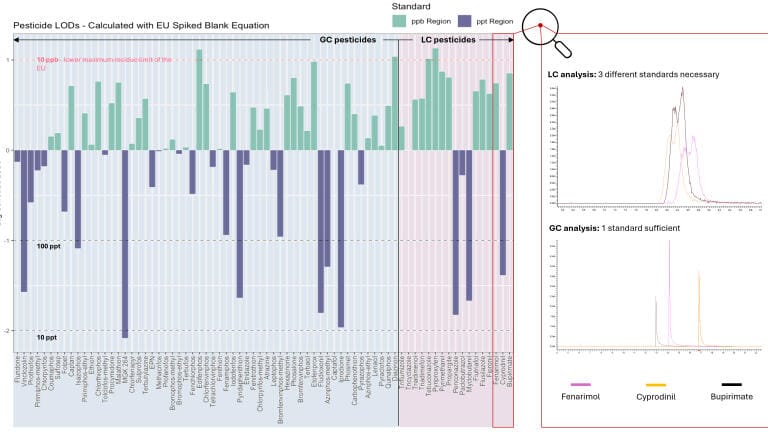
In a study using a GC-DBDI-QTOF setup, 74 pesticides from three multi-residue standards were evaluated across a five-point calibration range from 1 ppb to 1 ppm. LODs were calculated using the European Commission’s methodology (3.9 × Sb/slope). All measurements ran in full-scan MS¹ mode - no SIM, no MRM, no compound-specific optimisation.
70 of the 74 compounds reached LODs below the EU standard threshold of 10 ppb, and calibration curves showed strong linearity across all three standards. Hitting regulatory detection limits in untargeted full-scan mode isn’t trivial — it points to further headroom once the method is paired with targeted modes like SIM or MRM, or run on triple-quadrupole systems.
Sufficient sensitivity is one precondition for regulatory use; unambiguous identification is the other. Here the intact precursor ion pays off again: with a dominant [M+H]⁺ precursor, the confirmation workflow becomes much simpler. Data-dependent acquisition (DDA) can automatically trigger CID fragmentation for compounds of interest, and the resulting MS² spectra come from a clearly defined precursor under controlled collision energies — the same experimental framework used for LC-MS/MS confirmation.
Because the precursor ions generated this way are chemically equivalent to those from ESI, MS² spectra from GC-DBDI acquisitions can be matched directly against existing LC-MS/MS spectral libraries, with no translation or adaptation needed. For diazinon, for instance, the MS² spectrum matched the Shimadzu LC-MS/MS library entry as the top hit.
Having shown sensitivity and confirmation capability on a smaller compound set, the next question was how far the approach scales - and how much of the relevant compound space a single method can realistically cover. GC and LC methods have traditionally split that space by chemical property: volatile and semi-volatile non-polar compounds to GC, polar and thermolabile ones to LC. Many pesticide panels contain compounds from both categories, and no conventional single platform covers both.
This question was examined, among other studies, in work carried out as part of a PhD project at the Technical University of Munich, using the same GC-DBDI- QTOF setup. 687 pesticides - spanning both GC- and LC-suited compound classes - were analysed, with 99.1% detected in a first pass without any optimisation. Notably, classically LC-bound compounds were measured via the GC separation without any derivatisation, because DBDI ionisation isn’t restricted to polar or non-polar analytes the way ESI and EI are. The linear dynamic range exceeded three orders of magnitude, and sensitivity met EU MRL thresholds for every compound detected. Switching from helium to hydrogen as carrier gas cut runtime by around 40%, to 15 minutes, with no loss in chromatographic resolution, MS performance or spectral quality.
These analytical gains carry a direct infrastructure dimension. A conventional lab running GC-MS and LC-MS as separate platforms maintains two independent ecosystems: two mass spectrometers, two ionisation sources, two spectral library formats, two method-development pipelines.
With a shared ion source for GC and LC, both separation methods draw on the same ion chemistry, the same spectral library and the same confirmation workflow. That doesn’t make GC-EI or LC-ESI obsolete - there will still be applications that specifically need EI fragment patterns for identification, or ESI for compounds that can’t survive a GC separation. What’s new is a third category: applications, like pesticide analysis, where a single ionisation approach covers both compound spaces on one unified MS platform. For that category, the infrastructure and workflow overhead described above drops noticeably - one platform instead of two, one shared spectral library, less duplicated method development, and a lighter maintenance and training load.
Soft ionisation paired with GC doesn’t just change spectral quality - it enables a fundamentally different analytical workflow. A DBDI-based ion source produces spectra dominated by intact molecular and quasi-molecular ions, with detection limits that for many substances match or exceed established GC-MS methods, and it enables MS/MS confirmation through direct matching against LC-MS/MS libraries. The decisive shift isn’t that GC and LC get measured in a single run - it’s that the boundary between the two domains moves. For labs currently running GC-MS and LC-MS as separate worlds, DBDI offers a way to dissolve that boundary without giving up the analytical depth of either method.
ILM 51.6 Sept 2026




 Product directory














.jpg)



.jpg)

.jpg)