Laboratory products
Researchers at Pittcon 2026 outlined how molecularly imprinted polymer sensors, cell-based platforms and field-deployable microfluidics could work together to link molecular recognition with real-world water quality monitoring.
Water quality is commonly evaluated using the types and concentrations of pollutants, nutrients, pharmaceuticals and biomolecules. Such chemical information is essential for water-quality assessment, whereas concentration data alone do not clarify where a chemical species originates, which chemical form is biologically active, how it interacts with cells or whether a molecular event is associated with an ecosystem-level effect. As analytical targets have expanded beyond regulated contaminants to include transformation products, biomarkers and trace-level components in complex environmental mixtures, understanding their sources, chemical forms and biological effects has become increasingly important.
Conventional analytical methods, including chromatography and mass spectrometry, provide a reliable foundation for identifying and quantifying chemical species in complex samples. These capabilities are essential for determining chemical composition and validating measurements obtained using complementary analytical platforms. These methods are widely used in laboratory settings, although their requirements for instrumentation, sample preparation and trained operation can limit routine in situ or continuous use. Meanwhile, chemical sensors can complement these methods by enabling the rapid, local or continuous acquisition of chemical information at or near the sampling site. Therefore, chemical sensors can increase measurement frequency and retain the spatial and temporal context of a sample, thereby revealing chemical changes between individual laboratory analyses. In cross-scale analysis, this capability is important because molecular recognition can be monitored under conditions relevant to subsequent cellular, microbial or environmental processes.
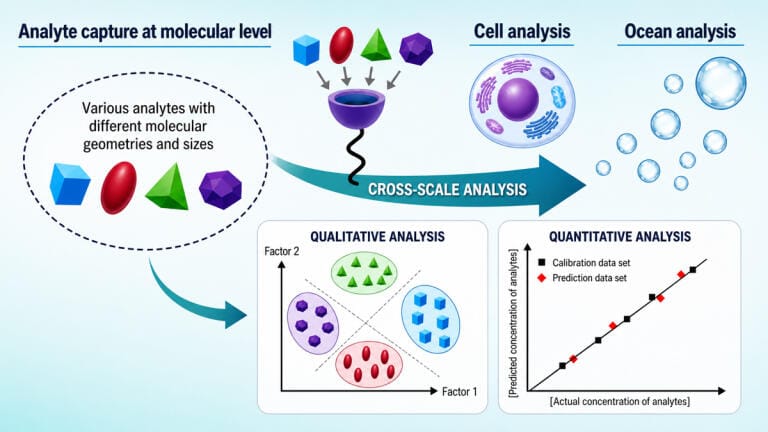
The Pittcon 2026 session ‘Cross-scale Analysis from Cells to Environmental Water’ brought together researchers addressing different parts of this analytical framework. The session was associated with the Japanese Grant-in-Aid for Transformative Research Areas (B) programme ‘Cross-scale analysis’, which integrated three complementary research groups. The molecular-scale group focuses on recognition chemistry and receptors capable of distinguishing structurally similar targets. At the cellular scale, advanced culture models are combined with sensor devices to evaluate biological responses at cellular and single-cell levels. Furthermore, at the environmental and ocean scales, microanalytical systems are developed for practical measurements under challenging field conditions (Figure 1). The programme linked these groups so that findings at one scale can guide the questions and measurements at the next. [1,2]
The symposium presented several complementary analytical approaches, including an organic electronic sensor functionalised with a supramolecular recognition material and a surface plasmon resonance platform for monitoring interfacial chemical information. [1] These platforms illustrate how otherwise invisible chemical information can be translated into detectable and interpretable signals by combining molecular recognition and signal transduction. The session also included presentations on microreactor arrays combining single-cell trapping and manipulation with aptamer-based electrochemical detection of cell-surface proteins, and an integrated absorbance and fluorescence device for the non-destructive monitoring of microbial responses to pharmaceuticals in environmental microcosms.
Power-free microfluidic platforms using a hydrostatic pressure difference as the driving force were also introduced for continuous fluid delivery, with potential application to long-term in situ measurements in aquatic environments. [1,3] Integrating these fluidic systems with molecular sensors or transistor-based devices could extend chemical sensing from molecular and cellular measurements to environmental monitoring. Together, these examples illustrate complementary analytical modules that could link molecular recognition with cellular and environmental measurements through the co-development of sensing interfaces, sample-handling systems and measurement platforms.
The significance of these contributions does not lie in identifying a single platform as a definitive cross-scale sensor. Rather, the individual devices occupy different positions in a linked analytical workflow. In this framework, a molecular sensor generates a target-dependent signal that can support analyte quantification after appropriate calibration. Next, a cell-based platform characterises biological responses under controlled exposure conditions, while an environmental platform provides spatial and temporal context for chemical and biological observations. Cross-scale analysis becomes possible when these outputs are aligned in analyte definition, experimental conditions, space and time, and are interpreted together to address a common scientific question.
From an architectural viewpoint, a chemical sensor device comprises three interdependent components:
• a recognition material for analyte capture based on ion or molecular recognition chemistry
• a sensing interface that couples the recognition event to the device
• a transducer that converts the interfacial recognition event into a measurable signal.
As part of this broader framework, extended-gate transistor sensing represents one approach for electrically reading changes at an electrode–electrolyte interface. In an extended-gate organic field-effect transistor (OFET), a functionalised electrode contacts the aqueous sample, whereas the organic semiconductor is isolated from the sample solution (Figure 2). Target binding within the recognition layer on the extended-gate electrode can alter the interfacial potential, thereby modulating the effective gate bias and consequently changing the OFET characteristics. Although the electrical output is read through the transistor circuit, molecular recognition and initial signal transduction occur at the sensing electrode. This architecture therefore combines electrochemical interface design with transistor-based electrical readout. [4,5]
Molecularly imprinted polymers (MIPs) are synthetic recognition materials prepared by polymerising monomers in the presence of a template molecule. [6] Interactions between the template and monomers organise the recognition sites in the polymer network. Following removal of the template, binding sites complementary to the target in size, shape and chemical functionality remain in the polymer. Because the composition and preparation conditions of the polymer can be adjusted according to the intended target and sample environment, MIPs provide a versatile platform for introducing molecular recognition into sensor devices.
When an MIP is formed on an extended-gate electrode, its binding sites can be positioned close to the electrode–electrolyte interface. Thus, molecular rebinding can alter the electrical state of this interface, and the OFET reads the resulting change through its transistor characteristics. [7,8] Indeed, previous work demonstrated cortisol detection in human saliva using an MIP-functionalised extended-gate OFET. [9]
Figure 2. An extended-gate OFET sensor. The sensing electrode is physically separated from the OFET channel and can be functionalised with molecular recognition materials.
Cross-scale analysis requires coordinated measurements that connect one scale to the next. Selective receptors can support targeted quantification after appropriate calibration, whereas cross-reactive receptor arrays or sensors that provide multiple distinct features can generate response patterns for multivariate classification or regression. [10,11] After immobilisation, the recognition layer must retain its selective or cross-reactive response, while the interface and transducer must convert that response reproducibly into a measurable signal. [11] A future direction of cross-scale analysis is to establish a feedback loop between environmental observation and molecular design. In this regard, field-oriented microfluidic systems coupled to appropriate sensors can support measurements of spatial and temporal changes in chemical composition, while cell and microbial platforms can assess biological responses under defined conditions. [3]
The resulting information can guide the selection of analytes, concentration ranges and recognition functions for the design of new chemical sensors. Reliable and thorough data analysis also requires calibration and validation datasets that represent variations in matrix composition, device batch, sampling location and measurement conditions. Genuinely independent samples should be retained for external validation.
Overall, the Pittcon session presented cross-scale analysis as a modular analytical strategy rather than a single integrated instrument. Molecular sensors, cell-based microreactors and environmental microfluidic systems can remain separate platforms, provided that compatible sampling procedures, calibration methods and data structures allow their outputs to address a common scientific question. Their integration also requires alignment of the measurands, exposure windows, spatial scales and uncertainties represented by each platform.
Accordingly, an MIP-functionalised extended-gate OFET is one example of converting interfacial molecular recognition into an electrical signal. Future progress will require improvements to individual platforms and the co-development of recognition materials, interfaces, transducers, sample-handling systems and data-analysis frameworks. Such an approach can connect molecular recognition with environmental interpretation while preserving the analytical meaning of information obtained at each scale.
This work was supported by JSPS KAKENHI Grant Number JP23H03863.
1. Pittcon 2026, “Cross-scale Analysis from Cells to Environmental Water”, symposium programme and presentations, 9 March 2026
2. Grant-in-Aid for Transformative Research Areas (B), “Cross-scale analysis”, The University of Tokyo, https://www.tminami.iis.u-tokyo.ac.jp/cross-scale/en/
3. Fukuba, T. “Power-saving/Power-free Pumping Technology for in situ Measurement in Aquatic Environments.” Bunseki Kagaku 2025, 74, 265–272. https://doi.org/10.2116/bunsekikagaku.74.265
4. Kubota, R. et al “Chemical Sensing Platforms Based on Organic Thin-Film Transistors Functionalized with Artificial Receptors.” ACS Sensors 2019, 4, 2571–2587. https://doi.org/10.1021/acssensors.9b01114
5. Sasaki, Y.; Minami, T. “Organic Field-Effect Transistors for Interfacial Chemistry: Monitoring Reactions on SAMs at the Solid–Liquid Interface.” ACS Applied Materials & Interfaces 2025, 17, 31165–31173. https://doi.org/10.1021/acsami.5c00297
6. Haupt, K.; Mosbach, K. “Molecularly Imprinted Polymers and Their Use in Biomimetic Sensors.” Chemical Reviews 2000, 100, 2495–2504. https://doi.org/10.1021/cr990099w
7. Zhou, Q. et al “An organic transistor for the selective detection of tropane alkaloids utilizing a molecularly imprinted polymer.” Journal of Materials Chemistry B 2022, 10, 6808–6815. https://doi.org/10.1039/D2TB01067D
8. Zhang, Y. et al “Accurate determination of enantiomeric excess of an amino acid using an extended-gate-type organic transistor.” Chemical Communications 2025, 61, 9872–9875. https://doi.org/10.1039/D5CC02191J
9. Sasaki, Y. et al “Accurate cortisol detection in human saliva by an extended-gate-type organic transistor functionalized with a molecularly imprinted polymer.” Sensors and Actuators B: Chemical 2023, 382, 133458. https://doi.org/10.1016/j.snb.2023.133458
10. Sasaki, Y.; Kubota, R.; Minami, T. “Molecular self-assembled chemosensors and their arrays.” Coordination Chemistry Reviews 2021, 429, 213607. https://doi.org/10.1016/j.ccr.2020.213607
11. Sasaki, Y.; Minami, T. “Cross-scale design of chemosensor arrays: from molecular self-assembly in water to paper-based devices for metal ion detection.” Beilstein Journal of Nanotechnology 2026, 17, 828–838. https://doi.org/10.3762/bjnano.17.59
ILM 51.6 Sept 2026




 Product directory














.jpg)


.jpg)

.jpg)