Laboratory products
Published over 14 years ago. See the latest and most current information on Laboratory products.
Anti doping efforts are not just confined to humans at this year's Games, with the competition's four-legged Olympians also coming under the laboratory microscope.
A Cambridge lab in the village of Fordham will take samples from animals that are competing in this year's Olympics, with horses tested for steroids, stimulants, masking agents, painkillers and other preparations.
HFL Sport Science has been in existence for 50 years now, and is generally used to test horses in the racing industry. However, this year the chemists and biochemists will be working extra shifts to perform the checking of blood and urine samples from every horse competing at the Greenwich Park arena during London 2012.
Dr Catherine Judkins, business development manager for HFL, said: "We're responsible for carrying out the anti-doping tests for the equestrian events, so that's dressage, show jumping and three-day eventing.
"It's been very busy over the last few weeks and especially the last few days. It's not just about the drugs... it's a welfare issue as well. We need to know the horse is being treated well and isn't being propped up by any medications."
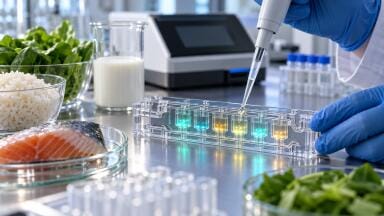
Along with blood and urine samples, the horses' feed is also tested for banned substances, which makes it all the more challenging from an extraction point of view. Detecting the tiniest trace amounts of banned substances in feed is a challenge in itself, which is why each sample undergoes a series of clean-up and purification steps all aimed at stripping the sample of all the stuff that the chemists are not really interested in.
The 'chain of custody' has been an important part of this year's anti-doping campaign, with anonymity being highlighted as being the key to a fair and successful programme. Each sample received in Olympic laboratories could end up being used in a legal case, which is why strict procedures must be adhered to from the collection of the sample to the results.
Posted by Fiona Griffiths
ILM 51.6 Sept 2026





 Product directory