
Laboratory products
Published over 6 years ago. See the latest and most current information on Laboratory products.
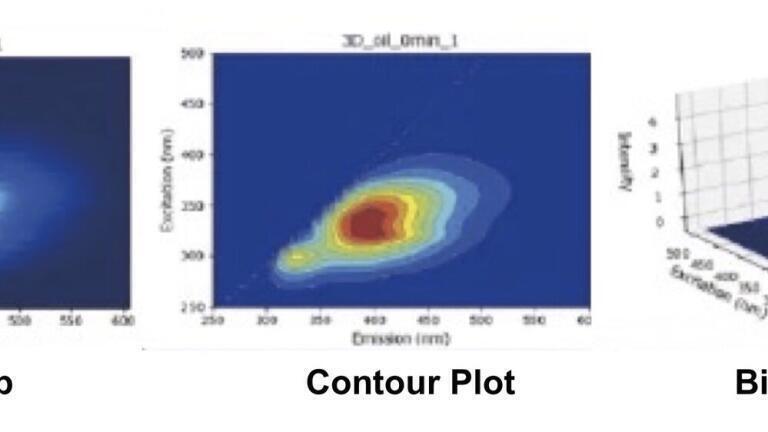
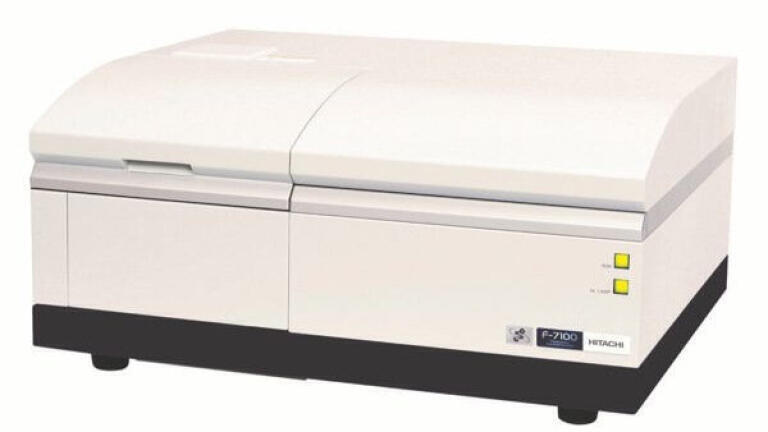
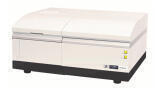
Fluorescence fingerprinting using the Excitation Emission Matrix (EEM) method is fast and easy using the Hitachi F7100 Fluorescence Fingerprint Measurement and Discrimination system from Lambda Advanced Technology. Using multivariate software for 3D scan analysis, this powerful system can acquire fluorescence fingerprints in just 2-3 minutes. The intensity of the fluorescent light emitted during a 3D scan is dependent on both the excitation and emission wavelengths. A fluorescence fingerprint is obtained by plotting these 3 parameters in three dimensions as an aerial view or contour map. The software classifies information from the fingerprints, such as composition, concentration and environmental load, for checking purity, abnormalities in raw materials, mixture compositions, freshness due to organic degradation, or determining the place of origin and more. Analysis is possible on liquid or solid samples and the system can be used in a host of industries:
3D EMM scans generate tens of thousands of data points for analysis and the F7100-based system provides fast and accurate data acquisition thanks to one of the fastest scan speeds in its class (60,000 nm per minute). It also features automatic setting of response processes for high-speed scanning, rapid excitation wavelength switching and a filter accessory which automatically removes the effects of higher-order light which would affect measurement accuracy. Data is transferred directly to the 3D SpectAlyze statistical multivariate analysis software which can automatically select the optimal wavelength for differentiating sample components, calculate the formulas for the discrimination library, resolve peaks from multiple components, and much more.
Since fluorescence fingerprint analysis measures the fluorescence possessed by the sample itself, there is little need for sample preprocessing such as grinding, dissolving, or filtration. Samples such as fruit fragments or raw meat can be analysed directly, meaning that even an inexperienced analyst can use the system. Fluorescence fingerprints from samples with known characteristics (such as place of origin) are first collected. The software performs multivariate analysis to create an ‘identification model’ of much fewer variables from these samples which is held in a reference library. Fluorescence fingerprints of unknown samples are then acquired and processed in the same way and the software compares them to the references to complete the analysis.
Applications include:
In addition to the basic system, the EEM Multi features a 98 well microplate accessory and a powder sample guide for continuous measurement of liquid or powder samples. For large, irregular shaped samples, the EEM Direct allows measurements to be made using an optical fibre.
Click here to find out more about the Hitachi F7100 Fluorescence Fingerprint Measurement and Discrimination system.
ILM 51.6 Sept 2026



 Product directory


.jpg)
.jpg)










.jpg)
.jpg)
.jpg)



.jpg)
