Research news
A cell-free peptide ligase display platform developed in Japan has enabled rapid, high-precision screening of target-binding peptides, achieving up to 10,000-fold enrichment in a single step and expanding the scope of drug discovery and diagnostics
A research team at the Innovation Center of NanoMedicine, Kawasaki, Kanagawa, Japan, has reported a novel cell-free platform that has significantly improved the efficiency and precision of peptide screening, with implications for drug discovery and molecular diagnostics.
The study, titled: ‘Peptide ligase–mediated display: A cell-free platform for tunable selection of affinity peptides’, has been co-authored by Dr. Shingo Ueno, Dr. Fumi Toshioka and Dr. Takanori Ichiki. The work has introduced a technique known as peptide ligase-mediated display (PL-display) which enables high-throughput identification of peptides that bind selectively to biological targets.
Biological systems rely on highly specific molecular interactions in which a ligand binds to a receptor defined by the three-dimensional conformation of a protein. Disruption of this ‘lock-and-key’ relationship through mutation or molecular interference can lead to disease. Drug discovery has therefore depended on screening approaches that identify compounds capable of binding to such targets with appropriate affinity and specificity. However, conventional screening platforms, particularly those that rely on living cells, have often suffered from variability in protein expression and have proved unsuitable for proteins that exhibit cytotoxicity or instability.
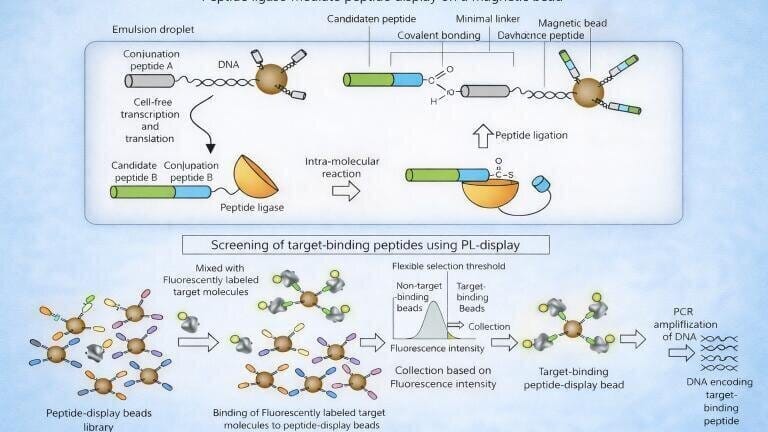
The research team has addressed these limitations through a cell-free protein synthesis approach that has enabled the production and display of peptides without reliance on cellular systems. In this platform, individual peptides have been immobilised on magnetic microbeads, with each bead presenting a single peptide species alongside its corresponding DNA sequence. This one-to-one linkage has allowed precise attribution of binding characteristics to specific genetic templates which has historically been a central requirement of display technologies.
A critical component of the system has been the use of a peptide ligase enzyme to form a stable covalent connection between peptides and their encoding DNA via a short linker sequence comprising nine amino acids. This design has ensured that both peptide and genetic information remain physically associated under stringent experimental conditions, including elevated saline concentrations and temperature regimes that would typically disrupt weaker interactions.
The platform has also incorporated fluorescence-activated cell sorting, a technique that enables the analysis and isolation of individual particles based on fluorescence intensity. By labelling target-binding events with fluorescent antibodies, the researchers have quantified binding strength at the level of single beads and have selectively recovered those that meet predefined thresholds.
This has enabled fine control not only to identify peptides with maximal affinity but also to isolate candidates with intermediate binding characteristics that may prove more suitable for therapeutic applications.
Experimental validation has demonstrated that the system can achieve highly selective enrichment of target peptides. When two marker peptides, ‘haemagglutinin’ tag and ‘histidine’ tag, were presented in equal proportions, fluorescence-based sorting successfully isolated only the desired population. Subsequent amplification of the associated DNA through polymerase chain reaction confirmed accurate recovery of the corresponding genetic sequences.
Notably, the method has achieved complete isolation of a target gene present at a frequency of just 0.01 per cent within a single round of selection. In a more complex library comprising approximately 1.7 million random peptide sequences, the system has enriched target-binding peptides within two selection cycles.
These results have indicated an enrichment efficiency of up to 10,000-fold in a single sorting step, representing a substantial improvement compared with established display technologies. The absence of cellular constraints has allowed the platform to accommodate proteins that are otherwise difficult to express or maintain, including those with toxic or unstable properties.
Furthermore, the uniformity of cell-free synthesis has reduced variability in peptide presentation, hence improving reproducibility and data reliability.
The robustness of the peptide-DNA linkage has also enabled rigorous washing and selection procedures which are essential to discriminate between weak and specific binding interactions. This has provided a level of experimental power that has proved to be difficult to achieve in cell-based systems, particularly when large and diverse peptide libraries are under investigation.
“By combining cell-free synthesis with peptide ligase-mediated immobilisation and fluorescence-based selection, we have established a platform that allows rapid and highly selective identification of target-binding peptides,” said Ueno, who led the study.
“This approach has enabled us to overcome key limitations of conventional display technologies, particularly in relation to efficiency, stability and the ability to handle challenging protein targets,” he said.
The implications of this work extend across multiple domains. In drug discovery, the ability to identify peptides and antibody fragments with precise binding characteristics has supported the development of targeted therapeutics. In diagnostics, selective binding molecules have enabled sensitive detection of disease-associated biomarkers. The platform has also shown potential for use in biomaterials science and industrial biotechnology, where proteins must function under non-physiological conditions.
The researchers have suggested that integration with automated workflows and robotic systems could further enhance throughput, particularly when combined with magnetic bead handling platforms. Such developments would align with broader efforts to accelerate molecular discovery through high-throughput and data-driven methodologies.
This study has demonstrated that cell-free display technologies can provide a robust and scalable alternative to traditional approaches, offering both improved efficiency and expanded experimental flexibility.
For further reading please visit: 10.1093/pnasnexus/pgag031
ILM 51.6 Sept 2026



 Product directory


.jpg)
.jpg)















,-photo-Karin-Allander.jpg)