
Research news
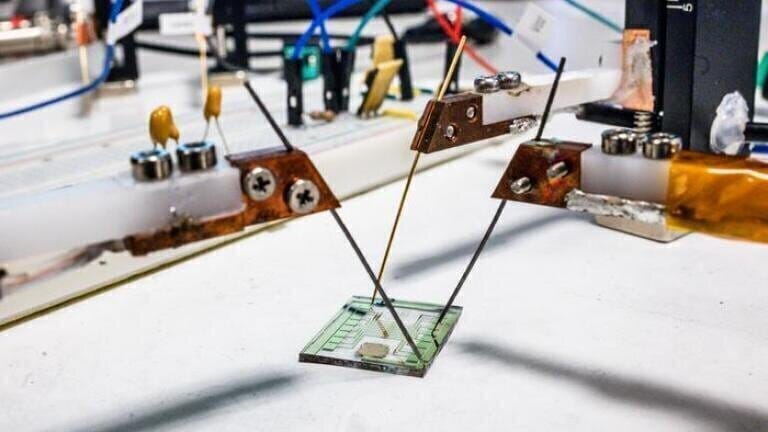
Scientists at Linköping University have created a highly compact artificial neuron from conductive plastics that replicates key functions of biological nerve cells. The breakthrough could transform body-integrated sensors, medical implants and soft robotics by enabling closer communication between electronics and living tissue
Researchers at Linköping University in Sweden have demonstrated an artificial neuron made from conductive plastics that can perform advanced functions comparable to those of biological nerve cells. The results are paving the way for the next generation of body-integrated sensors, medical implants and soft robotics.
“Mimicking the behaviour of biological neurons has long been a major goal in so-called neuromorphic engineering.
“Traditional silicon-based electronics fall short because they do not speak the same language as the nerve cells in our body,” said Professor Simone Fabiano, a materials scientist at Linköping University.
Rather than rely on rigid silicon, Professor Fabiano’s team at the Laboratory of Organic Electronics has worked with a class of soft, flexible materials known as conjugated polymers which can transport both ions and electrons. This dual capability allows them to communicate more naturally with biological systems and to perform signal-processing tasks that bridge organic and synthetic domains.
In their recent paper, the researchers have shown that these artificial neurons can carry out a form of information processing found in the human nervous system. The function, called ‘anticoincidence detection’, activates a neuron only when one input is present and another is absent. This selective response underlies functions such as tactile sensing and spatial recognition.
“We can [now begin to] imagine using these devices to add a sense of touch in prosthetics or robotics. They show that organic electronics are not merely softer alternatives to silicon but can enable new kinds of neural computing that connect biology with electronics,” said Professor Fabiano.
Alongside these advances in functionality, the group has sought to simplify the physical structure of the artificial neuron. In early 2023, researchers at Linköping’s Campus Norrköping created synthetic nerve cells that reproduced 15 of the 22 core properties of biological neurons. However, those earlier designs required multiple interconnected components which made practical application difficult.
In a subsequent study the team refined the system further, reducing the design to a single organic electrochemical transistor. Despite this simplification, the artificial neuron reproduced 17 neural properties and achieved a size comparable to that of a human nerve cell.
“This is one of the simplest and most biologically relevant artificial neurons made to date. It opens the door to integrate synthetic neurons directly with living tissue or soft robots,” said Professor Fabiano.
For further reading please visit: 10.1126/sciadv.adv3194
ILM 51.6 Sept 2026




 Product directory





















,-photo-Karin-Allander.jpg)