
Research news
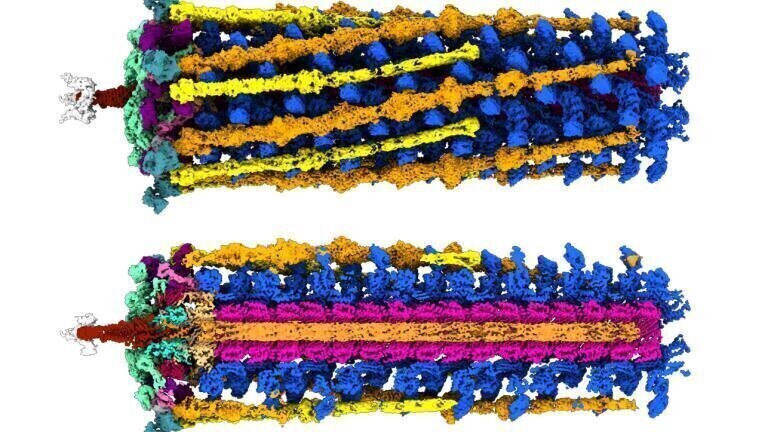
Researchers at the Okinawa Institute of Science and Technology and the University of Otago have resolved the full three-dimensional structure of bacteriophage Bas63 using cryogenic electron microscopy
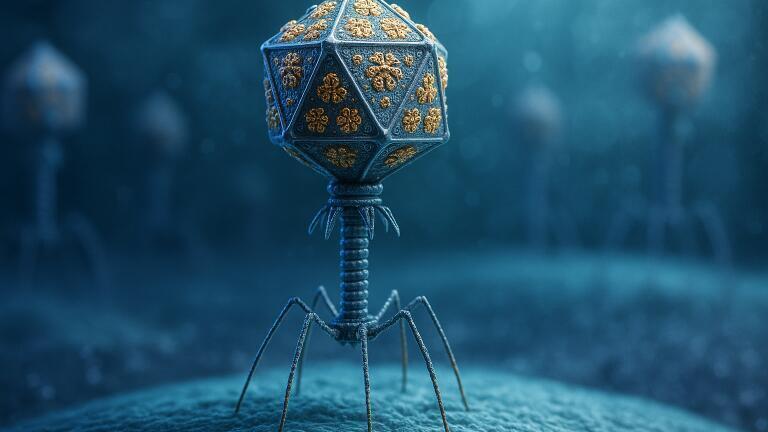
Bacteriophages have the potential to exert a major global impact in efforts to combat antimicrobial resistance. These viruses infect only bacterial cells and hold considerable promise as an alternative to antibiotics. However, the size, structural complexity and specific growth conditions of bacteriophages – or phages – have made them difficult to study in detail slowing progress in the field.
A research team at the Okinawa Institute of Science and Technology (OIST) Graduate University, Japan, and the University of Otago, Dunedin, New Zealand, has now described the bacteriophage Bas63 with unprecedented structural resolution. Their work has provided a detailed three-dimensional plan of the virus and has supported a deeper mechanistic understanding of how such bacteriophages function.
“Very few phages have been described at such a level of molecular detail,” said co-author Professor Matthias Wolf, head of the Molecular Cryo-Electron Microscopy Unit at OIST.
“By providing structural insights and biological understanding, we can enable [future] rational phage design and [potentially] transform how diseases are treated,” he added.
Bacteriophages are among the most abundant biological entities on Earth and were first discovered in the 1910s. Researchers recognised their potential to target bacterial infections very early. However, the field of phage therapy has remained largely underdeveloped because antibiotics emerged as a simpler option to manufacture, standardise and administer.
With antibiotic resistance now a critical global health concern, researchers have launched a renewed wave of phage research. Effective development of phage therapies, however, requires robust structural and functional data. To contribute to this evidence base, the OIST and Otago team selected Bas63 from the BASEL collection, which provides genomic and phenotypic data on more than 100 bacteriophages known to infect Escherichia coli.
“Bas63 has one of the most distinctive genomes and structures within its sub-family, based on straightforward low-resolution microscopy,” said co-author Professor Mihnea Bostina of the University of Otago, who is also a visiting scholar at OIST.
“This made it a prime target for high-resolution structural studies,” he said.
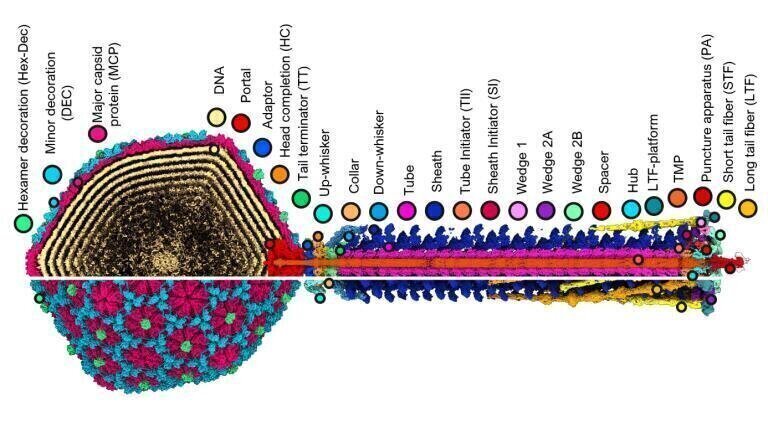
The team used cryogenic electron microscopy (cryo-EM) to resolve the full structure of Bas63 at high resolution. They applied a panning microscopy approach that effectively ‘walks’ along the virus, shifting the focus of the reconstruction step by step along its length. By combining amino acid sequence information with their cryogenic electron microscopy data, the researchers reconstructed the complete three-dimensional architecture of the bacteriophage and identified all major structural proteins in fine detail.
Among their findings, they reported a set of distinctive decoration proteins on the main body of the capsid, as well as a rare whisker and collar arrangement that links the phage head to its tail. These features may contribute to the stability and host-interaction properties of the virus, although further work will be required to define their roles.
Through comparison with proteins from other bacteriophages in the same sub-family, the team also identified candidate regions for future phage design and engineering.
“Significant sequence differences were found in the tail fibre proteins of the bacteriophages.
“This may indicate that they have a specific role in bacterial host recognition, so they could be important targets when researchers wish to design phages for high specificity,” said Professor Bostina.
The authors expect that their high-resolution Bas63 structure will act as a platform for research in medicine, agriculture and industrial microbiology.
“Outside medicine, bacterial pathogens can affect crops and livestock. Industries such as water treatment, food processing and energy production are also often challenged by bacterial biofilms,” said Professor Wolf.
“Beyond scientific applications, detailed three-dimensional information can be useful in design and animation, so artists, developers and educators may find creative inspiration from our data,” he concluded.
By providing a precise atomic-scale framework for Bas63, the study has illustrated how structural virology can support rational phage engineering. As concerns around antibiotic resistance continue to increase worldwide, such detailed maps of candidate therapeutic phages are likely to play an essential part in the development of targeted, bacteriophage-based interventions.
For further reading please visit: 10.1126/sciadv.adx0790
ILM 51.6 Sept 2026




 Product directory

















,-photo-Karin-Allander.jpg)