Research news
Zoldonrasib, an investigational therapy designed to inhibit the KRAS G12D mutation, has produced high tumour response rates when combined with first-line chemotherapy in an early-stage study presented at the ESMO Gastrointestinal Cancers Congress 2026
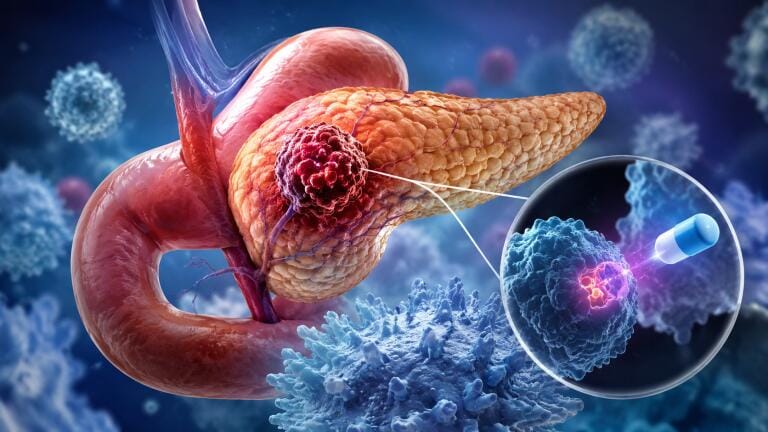
An investigational targeted therapy designed to block one of the most common genetic drivers of pancreatic cancer has shown promising early results when combined with standard first-line chemotherapy, according to research presented at the European Society for Medical Oncology Gastrointestinal Cancers Congress 2026, also known as the ESMO Gastrointestinal Cancers Congress 2026.
The Phase I/II multicentre study, led by researchers at Dana-Farber Cancer Institute in Boston, USA, evaluated zoldonrasib in patients with metastatic pancreatic cancer whose tumours carried a KRAS G12D mutation. The findings showed high rates of tumour shrinkage, substantial reductions in cancer-derived DNA detected in the bloodstream and no unexpected safety concerns.
Pancreatic cancer remains one of the world's deadliest cancers and one of the most difficult to treat. Many patients receive a diagnosis only after the disease has spread because early symptoms are often absent or non-specific. Curative surgery is usually no longer possible at that stage. Chemotherapy remains the standard first-line treatment for metastatic disease but its effectiveness is limited and the five-year survival rate remains approximately three per cent.
Around 90 per cent of pancreatic cancers harbour a mutation in the KRAS proto-oncogene – GTPase gene – usually referred to as KRAS. Approximately 40 per cent carry the KRAS G12D subtype, in which a specific alteration in the KRAS protein drives malignant growth. Until recently, KRAS G12D was widely regarded as an 'undruggable' target because of the protein's structure. Zoldonrasib – also known as RMC-9805 – belongs to a novel generation of investigational medicines designed to inhibit this mutation directly.
“The emergence of therapies designed specifically against KRAS G12D represents one of the most promising areas of research in pancreatic cancer today. For many years, this mutation was considered impossible to target, making these early findings particularly important,” said Dr Teresa Macarulla, head of the medical oncology department at Hospital Clinic Barcelona, Spain, and the co-chair of the ESMO Congress, but who was not involved in the study.
The study enrolled 81 patients with previously untreated metastatic pancreatic cancer carrying a KRAS G12D mutation at multiple cancer centres in the USA. Of these, 41 received zoldonrasib with modified FOLFIRINOX, a chemotherapy regimen comprising fluorouracil, leucovorin, irinotecan and oxaliplatin. The remaining 40 received zoldonrasib with gemcitabine and nanoparticle albumin-bound paclitaxel (nab-paclitaxel).
Among patients with sufficient follow-up, the objective response rate reached 82 per cent in those treated with zoldonrasib plus modified FOLFIRINOX and 61 per cent in those treated with zoldonrasib plus gemcitabine and nab-paclitaxel. Disease control was achieved in 96 per cent and 90 per cent of patients, respectively, indicating that most experienced either tumour shrinkage or disease stabilisation.
The researchers also reported strong molecular responses. Every evaluable patient experienced at least a 50 per cent reduction in circulating tumour DNA carrying the KRAS G12D mutation. Complete clearance of detectable mutant circulating tumour DNA was achieved in 47 per cent of evaluable patients who received modified FOLFIRINOX and 71 per cent of those who received gemcitabine plus nab-paclitaxel.
The safety profile was consistent with known chemotherapy-related adverse events, and no additional toxicities were identified. The most common treatment-related adverse events were diarrhoea, nausea and fatigue with modified FOLFIRINOX, and fatigue, nausea and decreased neutrophil counts with gemcitabine plus nab-paclitaxel. Grade 3 or higher treatment-related adverse events occurred in 61 per cent and 80 per cent of patients, respectively. However, no treatment-related deaths were reported.
“These findings are encouraging because they suggest that targeting KRAS G12D can be combined with standard chemotherapy without introducing unexpected safety concerns. However, this remains an early study involving a relatively small number of patients and it will now be important to confirm these results in the ongoing randomised Phase III trial,” said Macarulla.
The findings supported the launch of the global, randomised Phase III RASolute 305 trial, which will compare zoldonrasib plus chemotherapy with placebo plus chemotherapy in patients with previously untreated KRAS G12D metastatic pancreatic cancer.
“If these findings are confirmed, this approach could represent an important advance towards more personalised treatment for pancreatic cancer. It could also be explored in earlier stages of disease, where greater tumour shrinkage before surgery may improve patient outcomes,” said Macarulla.
ILM 51.6 Sept 2026



 Product directory


.jpg)
.jpg)














,-photo-Karin-Allander.jpg)







.jpg)
