Research news
A University of Maryland-led team has found a way to predict hidden, cell-by-cell differences in viral infection, resolving a puzzle in virus biology first identified by Nobel laureate Max Delbrück in the 1940s
An international team led by the University of Maryland (UM), Baltimore, USA, has developed a method to reveal hidden differences in how viruses infect individual microbial cells. The approach combines mathematical analysis of population-level data with direct measurements from single cells and addresses a biological problem that has persisted since the earliest quantitative studies of bacteriophages in the 1940s.
The study shows that measurements from large populations of infected cells can predict variation in two fundamental viral traits:
Conventional experiments usually estimate these traits as population averages which can conceal substantial differences between individual infections.
“Individual infections do not unfold the same way,” said Dr Joshua Weitz, the paper’s senior author and professor of biology at UM.
“Successfully quantifying that variation at the level of a single cell opens the door to develop predictive models of how viruses can be used therapeutically to confront drug-resistant pathogens and how viruses transform environmental health,” he added.
Weitz and his research group have spent the past decade developing the mathematical framework used in the study. It tracks how viral populations accumulate through successive rounds of infection and uses patterns in population-level data to infer events within individual cells, including variation in the time between infection and rupture.
To test the model, researchers in the laboratory of Dr. Debbie Lindell, professor of biology at the Technion – Israel Institute of Technology, Haifa, Israel, developed an assay to measure infection outcomes directly in individual cells.
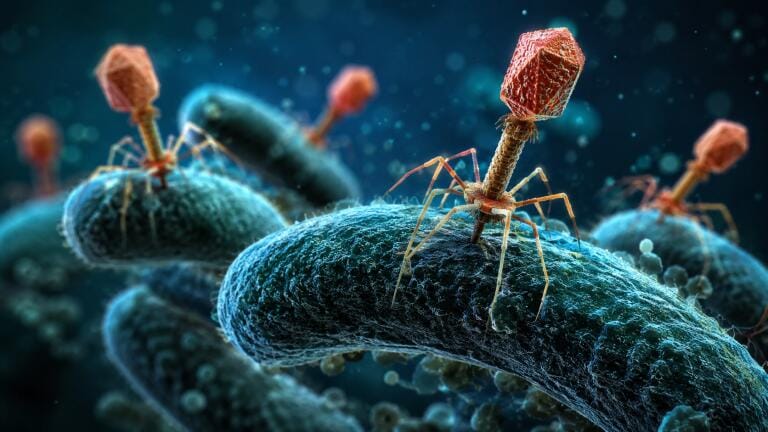
The researchers studied bacteriophages – or phages – which infect bacteria. Phages are among the most abundant biological entities on Earth and regulate microbial populations, nutrient cycles, ecosystem function and carbon movement. They have also attracted interest as potential treatments for antibiotic-resistant bacterial infections.
The study focused on a marine phage that infects an abundant open-ocean cyanobacterium. These photosynthetic bacteria contribute substantially to marine primary production*, and viral infection can alter their abundance while redirecting carbon and nutrients through marine food webs.
The experimental results closely matched their mathematical predictions. The researchers found considerable variation in the timing of cell rupture with some infected cells releasing viral progeny either earlier or later than others.
“Our findings contribute to solving an 80-year-old mystery on the sources of phenotypic variability in bacteriophages and advance the understanding of a core principle of the biology of viruses,” said Dr. Marian Dominguez-Mirazo, the paper’s first author. Dominguez-Mirazo has recently completed her doctorate in quantitative biosciences at the Georgia Institute of Technology, Atlanta, USA.
The team also identified an unexpected relationship between infection duration and viral production. Earlier studies had suggested that viral output would quickly reach a plateau. Instead, the researchers found that viral production generally continued to increase in proportion to infection duration.
“We saw a piecewise linear relationship – viruses generally kept producing offspring in proportion to the duration of infection, suggesting that viruses burst cells at different moments, often long before they run out of usable resources,” Weitz said.
The findings help explain a question first raised by Nobel laureate Max Delbrück during bacteriophage research in the 1940s at the Cold Spring Harbor Laboratory, Long Island, New York, USA. Delbrück had asked why burst size varies so widely between infected cells and this study has suggested that much of the variation arises because viruses rupture host cells at different times, making infection timing a potential evolutionary trait subject to natural selection.
The researchers said the method could prove valuable where direct single-cell measurements remain difficult or impossible, allowing scientists to recover biologically important variation from population-level experiments that would otherwise remain hidden.
“Because viruses that infect microbes influence everything from ocean ecosystems to bacterial disease dynamics, understanding the hidden variation of viral traits could improve predictive models in environmental science, microbiology and emerging therapeutic applications,” Weitz said.
* The process by which microscopic photosynthetic organisms in the ocean convert carbon dioxide and water into organic matter using sunlight
For further reading please visit: 10.1126/sciadv.aed6456
ILM 51.6 Sept 2026



 Product directory




















,-photo-Karin-Allander.jpg)







.jpg)
