Research news
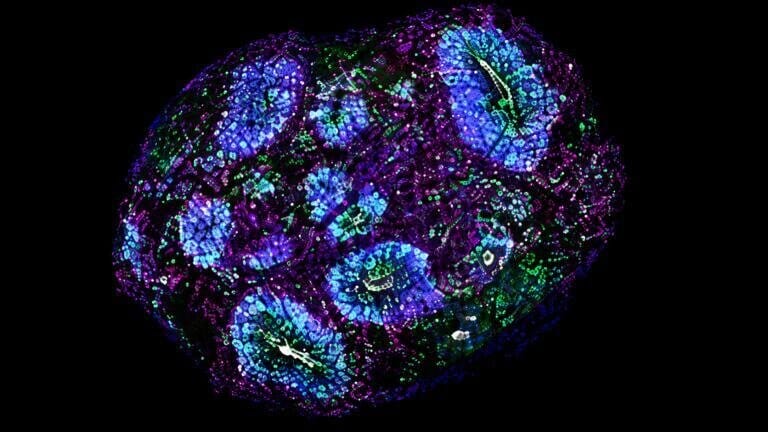
Human brain organoids cultured for more than five years continued to mature according to an intrinsic developmental clock, offering a laboratory model through which to study later stages of brain development
Researchers have maintained human brain organoids in laboratory culture for more than five years and found that the cells continued to mature according to developmental programmes that resemble those of the human brain.
The study could extend the use of brain organoids to research into later stages of human brain development, which have proved difficult to reproduce with existing laboratory models.
Brain organoids are three-dimensional structures grown from human pluripotent stem cells and designed to reproduce aspects of brain tissue. Most previous models have represented relatively early developmental stages and have survived for months rather than years.
A research team led by Dr. Paola Arlotta at Harvard University and the Broad Institute both of Cambridge, Massachusetts, USA, cultured cerebral cortex organoids for more than five years. The team examined 34 organoids and used single-cell RNA sequencing at multiple time points to track changes in individual cell populations.
Organoids aged between 15 days and two months displayed gene-expression changes comparable with those that occur during the first trimester of human foetal development. Organoids cultured for three to six months showed patterns associated with the second trimester, while samples maintained for more than 12 months developed gene-expression characteristics associated with the postnatal brain.
The researchers also used whole-genome methylation profiling to examine epigenetic changes. The predicted epigenetic age of organoids cultured from three months to five years correlated with the period that they had spent in culture. Different cell types matured at different rates which, in turn, reflected aspects of human brain development.
Further experiments indicated that cells retained information about their developmental history. The team combined cells from organoids cultured for nine to 12 months with cells from 15-day-old organoids. Older cells continued to produce neuronal types associated with later developmental stages rather than reverting to the developmental behaviour of the younger cells.
The findings suggest that human brain cells possess intrinsic mechanisms that allow them to record developmental time even outside the body.
The extended culture period could allow researchers to study processes that emerge after foetal development and investigate neurological and psychiatric disorders that develop later in life. Long-lived organoids could also provide laboratory models through which to assess how genetic variants influence brain maturation and response to potential treatments.
However, organoids remain simplified models. They lack many of the vascular, immune and systemic interactions present within a human brain and cannot reproduce the complete structure or function of the organ.
The researchers now aim to determine whether knowledge of the molecular mechanisms that control developmental timing could allow laboratories to accelerate organoid maturation rather than wait several years for cells to reach later developmental stages.
For further reading please visit: 10.1038/d41586-026-02585-3
ILM 51.6 Sept 2026



 Product directory




















,-photo-Karin-Allander.jpg)