Research news
Researchers in Spain and Argentina have developed a ring-shaped protein nanomaterial that binds to and neutralises SARS-CoV-2 more effectively than leading monoclonal antibodies, with potential to adapt the technology rapidly against future viral threats
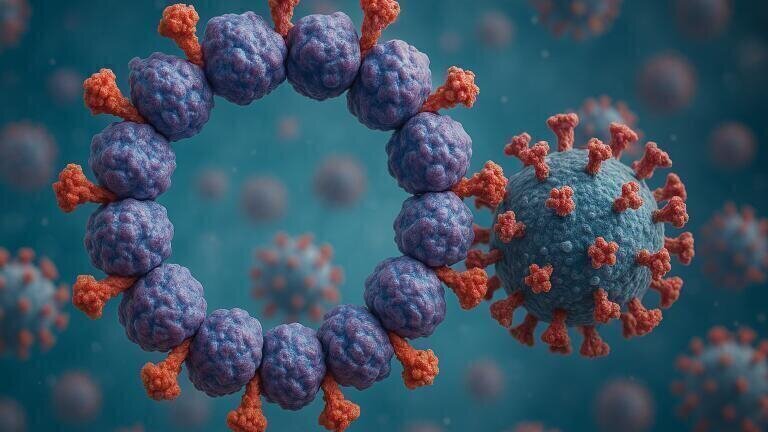
An international research team has developed a ring-shaped protein nanomaterial capable of strongly binding to and neutralising the SARS-CoV-2 virus. The study demonstrates the versatility of a modular system designed to engineer such ‘nanorings’, which can integrate both therapeutic and diagnostic functions and be adapted to counter other viral pathogens.
The work was undertaken jointly by scientists from the Institute of Biotechnology and Biomedicine at the Universitat Autònoma de Barcelona (IBB-UAB), in Spain, and the National Council for Scientific and Technical Research (CONICET) in Argentina.
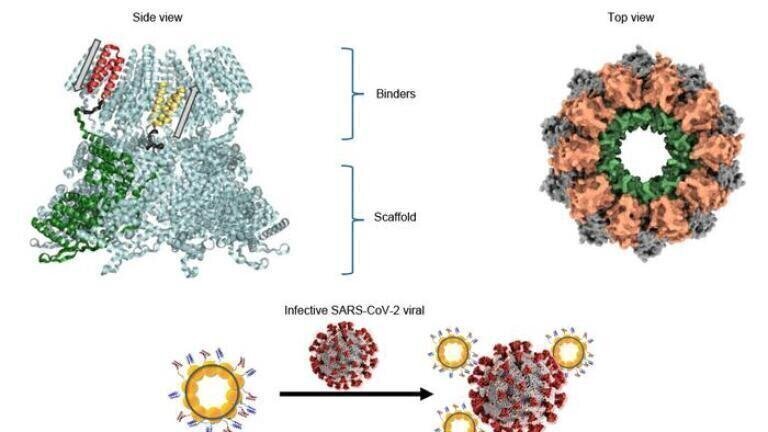
The nanomaterial comprises a scaffold built from recombinant ring-like proteins, to which the team incorporated mini-proteins previously engineered to target the viral spike protein of SARS-CoV-2. The resulting construct – termed RLP-1,3 – contains up to twenty attachment points for these mini-proteins and self-assembles into stable, biocompatible nanoparticles. These homogeneous particles adhere strongly to the viral Spike-ACE2 interface, effectively neutralising the virus and blocking cellular infection.
“The virus-binding activity of the nanoparticle exceeds that of benchmark monoclonal antibodies and clinically approved hyperimmune therapies,” said Dr. Salvador Ventura, director of the Parc Taulí Institute for Research and Innovation, in Barcelona, and a researcher at the IBB-UAB, who co-led the study.
“In addition, we have seen that [the technology] can also be adapted for the diagnosis of infection, with a detection level higher than that of commercial assays,” he added.
To create the nanoring, the researchers drew inspiration from naturally safe ring-shaped structures found in certain viral proteins.
“The result we obtained demonstrates how the integration of nanoscaffolds based on these architectures with the design of mini-proteins using artificial intelligence enables the creation of state-of-the-art multifunctional biomaterials,” said Dr. Damián Alvarez-Paggi, director of the Nanobioengineering Laboratory at CONICET.
The modularity of the system allows the ‘mini-proteins’ to be replaced with others designed to inhibit different viruses. The nanoring – now patented jointly by the Universitat Autònoma de Barcelona and CONICET – therefore provides a flexible platform that can host and exchange bioactive molecules to deliver therapeutic or diagnostic capabilities as required.
The researchers concluded that such versatility could offer a valuable tool to respond swiftly to emerging infectious diseases or future pandemics.
For further reading please visit: 10.1002/adhm.202503487
ILM 51.6 Sept 2026




 Product directory





















,-photo-Karin-Allander.jpg)