Research news
Wheat with unusually large starch granules has been developed at the John Innes Centre, with the potential to support slower-to-digest foods and improve starch use in industries from paper manufacture to pharmaceuticals
Scientists at the John Innes Centre, Norwich, UK, have engineered durum wheat, the variety used to make pasta, to produce much larger A‑type starch granules than conventional wheat. The advance could support slower‑digesting pasta and bread, with potential relevance for type 2 diabetes (T2DM), obesity and gut health, as well as offering benefits for industries that rely on starch.
Wheat starch normally contains a mix of large, flat A‑type granules and small, spherical B‑type granules. Granule size and shape affect how starch behaves during food manufacture, how quickly digestive enzymes break it down, and its usefulness in industrial processes. Larger granules tend to digest more slowly, because they present less surface area to digestive enzymes.
Starch that resists digestion in the upper gastrointestinal tract is known as ‘resistant starch’, a form of dietary fibre that can act as a substrate for the gut microbiome and may help to limit the extent post‑meal blood glucose spikes which have been linked to T2DM and obesity.
Beyond food, larger granules could benefit paper manufacture and packaging, where they are easier to separate, as well as pharmaceuticals, cosmetics and textiles, where starch is used for its binding and thickening properties.
The wider John Innes Centre team, including the lab of Dr David Seung, found that granule size is limited by two factors:
Using a Targeting Induced Local Lesions in Genomes (TILLING) mutant population, the researchers selected durum wheat plants carrying mutations in two genes, one linked to amyloplast size and the other to granule initiation and bred double‑mutant plants combining both traits. The method relies on conventional breeding rather than genetic modification.
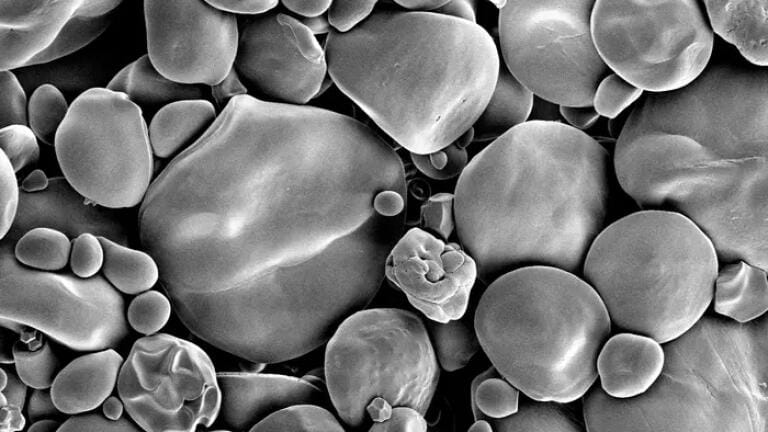
Scanning electron microscopy confirmed the plants produced A‑type granules up to 50 micrometres in size, more than double the typical 20 micrometres. More than half the granules measured 30 micrometres or more, compared with around six per cent in regular wheat starch.
“We were hoping our hypothesis would be correct, that with both a larger space to grow and less competition for substrate we would get bigger granules, but we were totally surprised by quite how big the novel granules were. We even needed to adjust the aperture on the particle size analyser to capture the full scale,” said Rose McNelly, first author of the study and a doctoral candidate at John Innes.
Natural variation in starch granule size among wheat cultivars is limited, meaning the result would have been difficult to achieve through standard crop selection alone, and the engineering approach was needed to test the underlying biological principle. The findings apply chiefly to cereal crops such as wheat and barley, which contain both A‑type and B‑type granules.
The Seung group and colleagues at the Quadram Institute, also based in Norfolk, UK, now plan to make pasta from the engineered wheat and test it in human studies, to establish whether the starch resists digestion and delivers benefits for blood glucose control and the gut microbiome. The same approach could also then be applied to wheat for making bread.
“It is a perfect example of fundamental science that may in future be useful for public dietary health and industry,” McNelly added.
Dr Fred Warren, a group leader at the Quadram Institute and a study co‑author, said: “Variation in starch granule size within a single cereal crop is highly novel and we do not yet know what the impact may be on food digestion and the gut microbiome. At Quadram Institute we are collaborating with the John Innes Centre to understand what the implications could be for the development of novel foods with additional health benefits.”
For further reading please visit: 10.1126/sciadv.a
ILM 51.6 Sept 2026



 Product directory



















,-photo-Karin-Allander.jpg)







.jpg)
