Research news
Researchers at National Taiwan University and Academia Sinica have, for the first time at atomic resolution, unveiled how the human proteasome recognises branched ubiquitin chains — a discovery that sheds new light on protein quality control and could have broad implications for understanding cellular regulation.
Protein degradation is central to maintaining cellular health, and the ubiquitin–proteasome system (UPS) serves as the cell’s primary mechanism for identifying and eliminating unwanted or damaged proteins. While homotypic K48-linked polyubiquitin chains have long been considered the canonical signal for degradation, how the proteasome reads these signals — especially more complex branched chains — has remained largely mysterious.
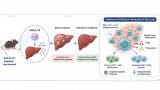
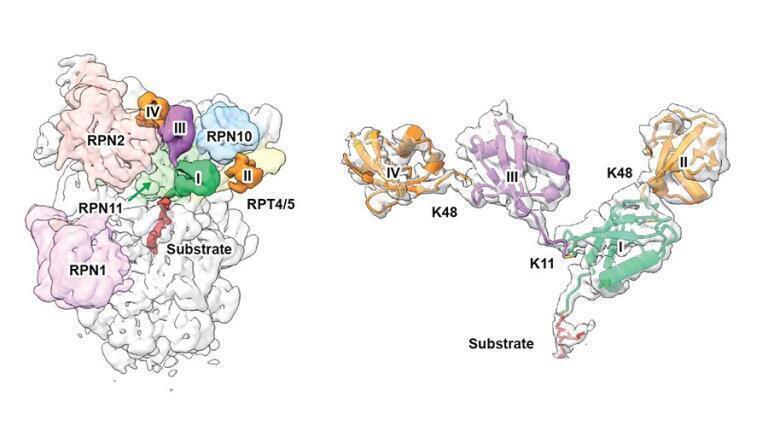
The team, led by Dr Shang-Te Danny Hsu, used an integrated approach combining cryo-electron microscopy, ubiquitin absolute quantification mass spectrometry (Ub-AQUA), and cross-linking mass spectrometry to capture the first high-resolution structure of the proteasome bound to a branched K11/K48-linked ubiquitin chain. Their findings [1] reveal a previously unrecognised K11-specific binding site on the proteasomal subunit RPN2. Together with other subunits, this forms a multivalent recognition groove that enhances substrate specificity and accelerates protein degradation.
“This integrated ‘structure + topology + absolute quantification’ strategy allowed us to resolve a question that has challenged the field for years,” said Professor Hsu. The study demonstrates that cells can rapidly eliminate key regulatory proteins, fine-tuning responses to stress and controlling protein homeostasis with remarkable precision.
Published in Nature Communications, the work represents a significant step forward in understanding how the proteasome deciphers complex ubiquitin signals and opens new avenues for research into diseases linked to protein degradation errors, including neurodegeneration and cancer.
More information online
ILM 51.6 Sept 2026




 Product directory


















,-photo-Karin-Allander.jpg)