Research news
Researchers have demonstrated a new way to dramatically increase the intensity of high-power laser light by harnessing a relativistic plasma effect predicted by Einstein’s theory of relativity.
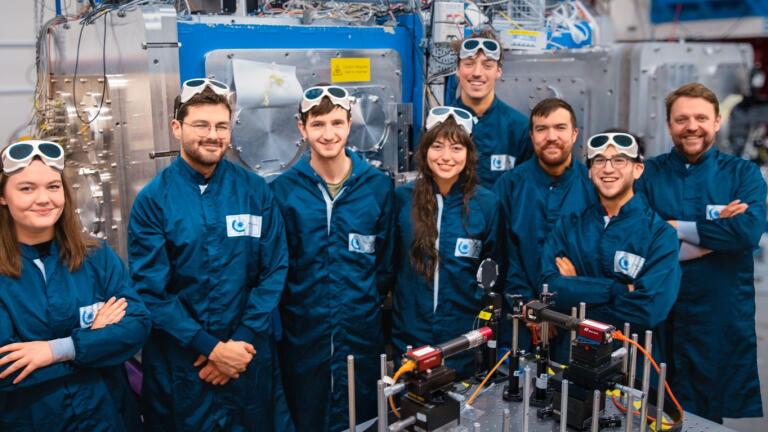
The international team, led by Professor Peter Norreys and Dr Robin Timmis at the University of Oxford and working in close collaboration with Professor Brendan Dromey and Dr Mark Yeung at Queen’s University Belfast, together with the UK’s Science and Technology Facilities Council, used the Gemini laser to generate extreme ultraviolet light by reflecting intense laser pulses off a rapidly moving plasma. Acting like a ‘relativistic mirror’, the plasma compresses and boosts the energy of the reflected light.
The researchers also introduced a second-stage focusing method, termed a ‘coherent harmonic focus’, which combines multiple wavelengths of light into an ultra-small focal region, dramatically increasing energy density.
Together, these effects could allow scientists to reach previously inaccessible light intensities and directly probe how light interacts with matter under extreme conditions described by quantum electrodynamics (QED).
Traditionally, such experiments require complex collisions between particle beams and lasers, with results reconstructed from multiple reference frames. The new approach allows interactions to be observed directly within the laser system, simplifying analysis and improving experimental clarity.
“This work brings together laser physics and plasma science in a way that resolves a long-standing mismatch between theory and experiment,” said Professor Brendan Dromey.
The study [1], published in Nature, suggests the technique could open new pathways for high-field physics research and potentially support future advances in precision applications, including medical technologies such as targeted cancer treatments.
More information online
ILM 51.6 Sept 2026



 Product directory


.jpg)
.jpg)
















,-photo-Karin-Allander.jpg)