Research news
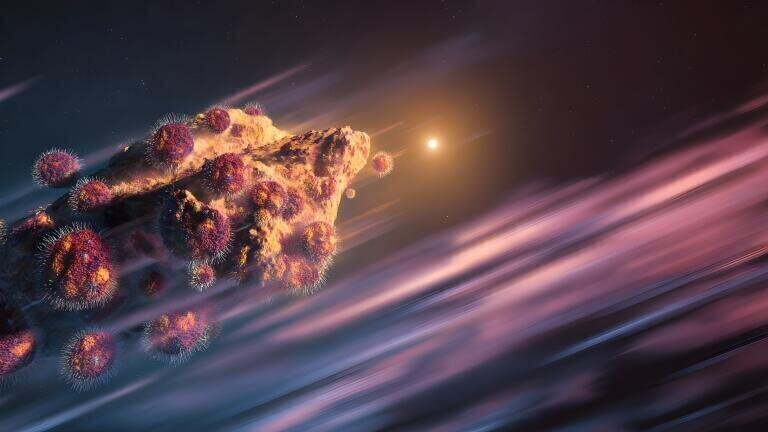
Biofilms - the microbial ‘cities’ that surround and protect microorganisms - are everywhere on Earth, supporting essential functions in humans, plants, and ecosystems. Now, researchers are uncovering their critical role in space, where long-duration missions could be affected by changes in these ancient microbial communities.
A new Perspective article in npj Biofilms and Microbiomes, led by teams at the University of Glasgow, Maynooth University, and University College Dublin, explores how biofilms influence human and crop health during spaceflight and what this means for life on Earth. The study [1] was coordinated through NASA’s Open Science Data Repository, part of the GeneLab Microbes Analysis Working Group.
“Biofilms are often seen as a problem to eliminate,” said Dr Katherine J. Baxter, first author from the University of Glasgow, “but they are the prevailing microbial lifestyle supporting healthy biological systems. Spaceflight offers a unique testbed to study biofilm organisation and function, helping us safeguard health during missions.”
Spaceflight and ground-based simulations can alter biofilm architecture, gene regulation, signalling, and stress tolerance - effects that vary across species and experimental platforms. Using advanced genetics and ‘multiomics’ approaches, the researchers outline a roadmap to understand complex, multi-species biofilms and their interactions with hosts, including plants.
“Plants will sit at the centre of long-duration missions,” said Dr Eszter Sas from Maynooth University. “Their performance depends on biofilm interactions around roots. Multiomics is helping us uncover new mechanisms of signalling and metabolism in these systems.”
The study highlights the two-way benefits of space biofilm research. Observations in space can reveal how life responds to extreme environments, while insights gained may improve human health and agriculture on Earth. Professor Nicholas J. B. Brereton of University College Dublin added: “Open science and international collaboration allow us to translate discoveries from space into real-world applications.”
The authors call for coordinated, open biofilm research beyond narrow model systems, combining analogue and cross-mission experiments to accelerate understanding and interventions for both space and Earth applications.
More information online
ILM 51.6 Sept 2026



 Product directory












,-photo-Karin-Allander.jpg)