
Research news
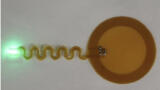
Researchers from University of Glasgow, University of Tsukuba and National Institute of Advanced Industrial Science and Technology have developed a compact superconducting chip that could accelerate the adoption of terahertz imaging across healthcare, research and security applications.
The device harnesses terahertz radiation — a region of the electromagnetic spectrum between microwaves and infrared — to probe materials non-destructively. Because these waves can pass through many substances while revealing their unique molecular ‘fingerprints’, they offer powerful capabilities for identifying and analysing biological and chemical samples.
Despite this promise, terahertz imaging systems have so far been limited by bulky designs, high power demands and restricted tunability. The newly developed chip aims to overcome these barriers by generating stable, tunable terahertz waves directly on a microchip, opening the door to more portable and energy-efficient systems.
At the heart of the technology is a crystal made from bismuth strontium calcium copper oxide (BSCCO), a high-temperature superconducting material. Its structure enables the creation of coherent terahertz emissions, allowing detailed imaging of a wide range of materials.
In laboratory tests, the team demonstrated the chip’s ability to capture fine structural details in metals, plant tissues and biological samples. It successfully imaged concealed objects, such as surgical blades inside sealed envelopes, and revealed subtle differences in food samples, including variations between fatty and lean regions of meat. The system also distinguished between visually similar granular materials — such as salt, sugar, flour and curry powder — based on their distinct spectral signatures.
These capabilities highlight the technology’s potential for applications ranging from security screening and pharmaceutical inspection to food quality control and environmental monitoring.
According to Manabu Tsujimoto, of the National Institute of Advanced Industrial Science and Technology, terahertz technologies have long been constrained by practical limitations. The team’s on-chip superconducting emitters demonstrate how advances in quantum materials could help unlock their wider use, enabling compact systems capable of both imaging and material identification.
Kaveh Delfanazari, of the University of Glasgow’s James Watt School of Engineering, added that the current system produces images with around 1 mm resolution in laboratory tests, taking approximately 15 minutes per scan. While further work is needed to improve speed and resolution, the results demonstrate that chip-scale superconducting sources could enable compact, tunable terahertz emitters, bringing practical, real-time imaging systems closer to reality.
The findings [1] are reported in IEEE Transactions on Applied Superconductivity.
More information online
ILM 51.6 Sept 2026



 Product directory




















,-photo-Karin-Allander.jpg)







.jpg)
