Microscopy & microtechniques
Published over 12 years ago. See the latest and most current information on Microscopy & microtechniques.
A new report has found that new imaging technology could potentially make a significant difference to the quality of microscope images.
Traditionally, the complex nature of biological samples has made them difficult for scientists to interpret. Because it is hard to anticipate how light will bend as it passes through the sample, images are often distorted, which can make research and the diagnosis of medical conditions much more complicated.
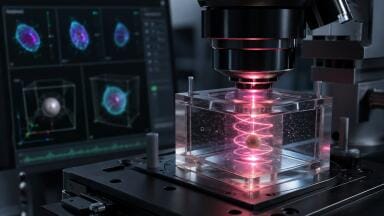
However, findings published in the journal Nature Methods show that a new technique could help to sharpen the end result. The report shows how the new method brings into focus the structure of brain cells in a zebrafish, which is used as an important model in biological research.
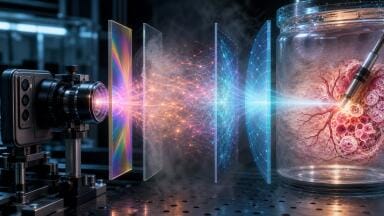
Eric Betzig, who led the research group, says the technology employs adaptive optics strategies used by optometrists and even astronomers to cancel out distortion in their own images. In both cases, distortion is measured and monitored so that it can be factored out of the final image.
Because it works in tissues that do not scatter light, scientists at the Howard Hughes Medical Institute say their approach is “well suited” to imaging organisms with transparent bodies. It also corrects for the distortion that often comes with standard microscope images and leaves sharper, high-resolution images that cover bigger volumes of tissue.
The new technique makes sure that corrections can be updated in as little as 14 milliseconds to keep the image as clear as it possibly can be. This is especially important when imaging larger samples, since microscopes often have to take thousands of images of smaller samples very quickly and each will need its own set of corrections.
“When we compare the image quality before and after correction, it's very different. The corrected image tells a lot of information that biologists want to know,” says Kai Wang, postdoctoral research fellow at the Howard Hughes Institute.
“Our technique is really robust, and you don't need anything special to apply our technology. [In the future] it could be a very convenient add-on component to commercially available microscopes.”
ILM 51.6 Sept 2026





 Product directory


.jpg)