Microscopy & microtechniques
Published over 12 years ago. See the latest and most current information on Microscopy & microtechniques.
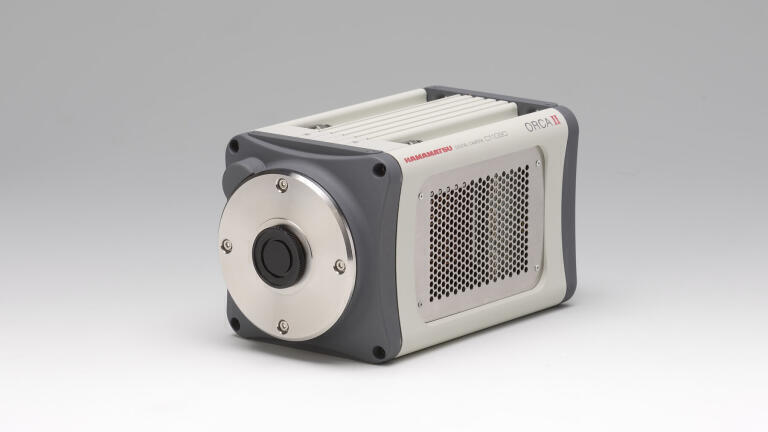
Hamamatsu Photonics introduces the successor to the ORCA II range. The new ORCA II is pushing the limits in ultra-low light detection and now comes with a 1M pixel Back-thinned CCD (BT-CCD), cooled down to -90°C and programmable trigger signal output. This restricts dark current to 0.0012 electrons/pixel/seconds and provides very high quantum efficiency (QE) across the broad spectrum of 200 nm to 900 nm with a peak QE >90%. These key features, together with extremely long exposure times (of up to 120 minutes), allows for the detection of even the faintest light. The new camera is supplied with programmable trigger signal outputs to guarantee precise measurement control and data capture.
This camera is ideal for applications including luminescence and low level fluorescence imaging, high resolution microscopy or semiconductor imaging, as well as X-ray applications, neutron radiography or scintillator readout.
ILM 51.6 Sept 2026





 Product directory