Microscopy & microtechniques
Published over 12 years ago. See the latest and most current information on Microscopy & microtechniques.
Global demand for environmentally friendly materials has increased drastically over the last few years making it a multi-billion pound industry. This in turn has driven the demand for the production and research into biodegradable plastics such as poly(butylene succinate), PBS. Teams from Beijing National Laboratory, Beijing Key Laboratory of Clothing Materials and Tianjin University in China have been looking into the structural characteristics of these plastics to see how they are affected by tensile forces.
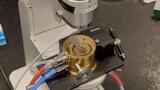
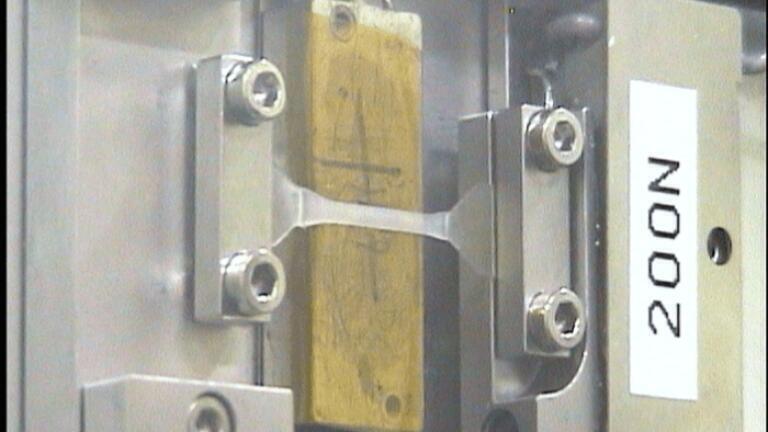
As always, with the growing popularity and necessity of such products, a lot of behind-the-scenes research needs to be carried out in order to ensure that the materials are fit for purpose. The teams in China have been using a Linkam TST350 tensile stage to look at the properties of these materials. In particular, the stage has been used to observe the recoverability of structural parameters once a force had been applied to it.
The researchers were interested to see how the alternatively packed crystalline and amorphous layers of the semi-crystalline polymer behave during the deformation of the plastic caused by stretching it. The stage was used in conjunction with an X-Ray synchrotron to observe the polymer when subjected to stretching experiments whilst accurately controlling the temperature of the sample at various temperatures between 20°C and 200°C.
The team found that the equipment was “…small and easy to set up, which allowed us to use it in combination with an optical microscope or synchrotron”. They also added that “The displacement control was surprisingly good” and that the TST350 was the only example of a tensile hot-stage that they have ever come across.
The importance of understanding the processes that occur in the deformation of these materials is vital in the search for a perfect biodegradable material. The research being carried out on such materials will hopefully help us become less and less reliant on the use of everyday which are taking a large toll on the already stretched environment.
ILM 51.6 Sept 2026


 Product directory