Incredible Images Launch International Year of Light 2015
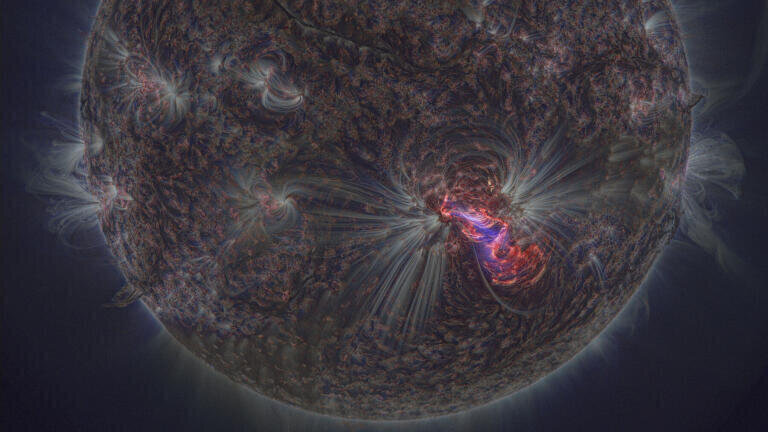
This dramatic image, captured by the orbiting Solar Dynamics
Observatory, shows one of the most active sunspot groups
observed in the last few decades. Solar active region AR2192
was the source of six solar flares of the largest class (X-class) in
October 2014. This image was gathered in extreme ultraviolet
wavelengths - 193 ångstroms in blue, 171 ångstroms in white
and 304 ångstroms in red (one ångstrom is a ten billionth of
a metre). The UV light comes from highly ionised helium and
iron atoms in the Sun’s outer atmosphere, and shows very
clearly how the atoms congregate along the intense magnetic
field lines. The rest of the Sun’s surface, so bright to our eyes,
appears dark at such extreme wavelengths. This exceptionally
sharp image was created by processing the raw data using special software called NAFE. Credi: NASA/SDO/AIA, processing by Miloslav Druckmuller
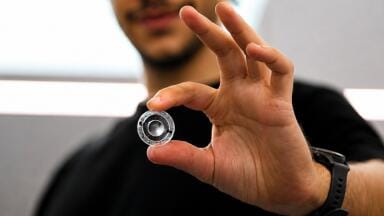
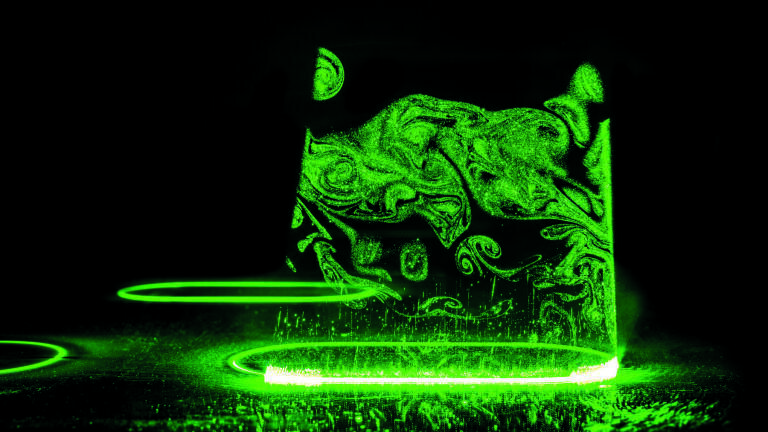
The very things that make glass for smartphones useful - their
hardness and thinness - make them almost impossible to cut to
shape by conventional means. Extremely fast lasers make the
job possible. By scanning across cut lines several times using
superfast pulses of light, the laser can cut the strongest types
of glass in any shape and with a smooth edge contour. This
removes the need for lengthy shaping and polishing operations.
The laser produces pulses of a few tens of picoseconds (million
millionths of a second) duration at a rate of tens of millions of
pulses per second. This prevents localised heat build-up which
could cause stress fractures in the glass .Credit:Fraunhofer Institute for Laser Technology ILT, Aachen, Germany / Volker Lannert
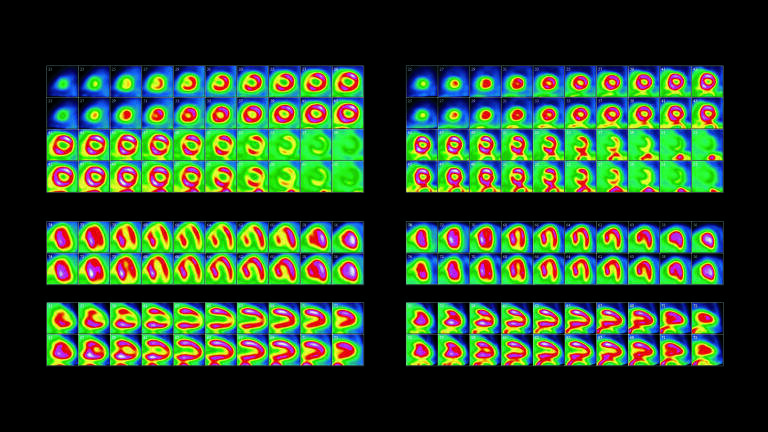
Myocardial Diffusion Imaging shows a patient’s heart before
and after surgery. To obtain the images, the patient was injected
with a chemical that binds to active myocardial (heart muscle)
tissue, and includes rubidium-82, a radioactive marker. This
emits gamma rays, so a gamma camera can make multiple
scans to create a 3D map of the active heart muscle. Here the
upper block shows slices from top to bottom of the heart, the
middle block shows slices from back to front and the lowest
block slices from the centre of the body outward. Alternate rows
show the heart stressed and resting. In the array of images at
left there are areas of significant missing activity, particularly
in the stress images. This is due to a 99% blockage of the left
anterior descending coronary artery. The blockage was treated
by implanting a stent (mesh-like tube) at the blockage site.Credit:Dr Eric Hong Cho Tek, EH Heart Specialist
Private Limited, Singapore
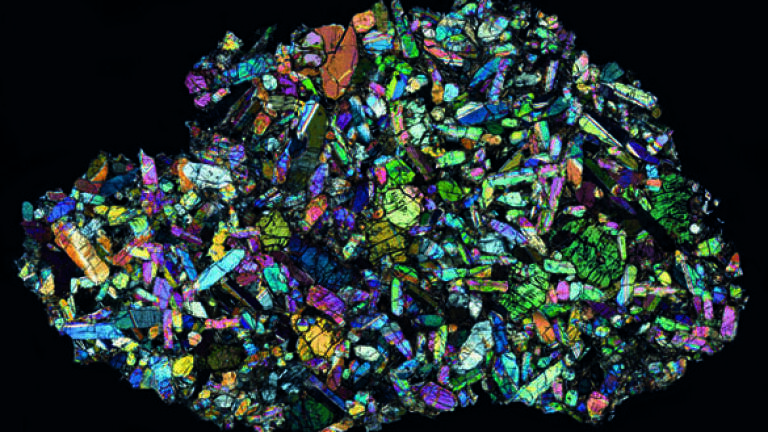
A view of a thin section through a Martian meteorite found
at Nakhla, Egypt, in 1911. The sample is lit from below with
polarised light, then another polarising filter is placed between
the sample and the eyepiece. Different minerals rotate polarised
light by different amounts creating characteristic colours, so the
technique allows scientists to determine the minerals present.
This rock is a clinopyroxinite consisting largely of augite and
olivine with smaller amounts of other minerals. It is thought that
this rock formed around 1.38 billion years ago on Mars. It was
blasted from the surface of the planet by a huge impact event,
meandering its way through the Solar System for an unknown
time before hitting the Earth’s atmosphere and breaking up.
This sample is approximately 13mm across. Credit:© Natural History Museum London BM1913,
2642 and the Open University Virtual
microscope

Microscopy & microtechniques

Incredible Images Launch International Year of Light 2015

29 Jan, 2015

Published over 11 years ago. See the latest and most current information on Microscopy & microtechniques.

Images from around the world defining what we see at the largest and smallest scales, including some that are normally invisible to the human eye, are just part of a new photography exhibition which opened in London and is currently on a national tour.

Organised by the Royal Photographic Society (RPS) with support from the Royal Astronomical Society (RAS) and the Science and Technology Facilities Council (STFC), Curated by RPS Fellow Gary Evans, Light Works celebrates the International Year of Light 2014 and on a virtual journey through the electromagnetic spectrum from gamma rays to radio waves, it explore ways of looking into our own bodies and the world around us.  The stunning images will offer something to everyone, regardless of their age or level of knowledge.

Gary Evans said: “With images so ubiquitous in the world today it was clear that the Royal Photographic Society needed to do something special to celebrate the International Year of Light. A ‘walk through the electromagnetic spectrum’ was the way to go, the hard part was settling on 50 images that not only have a rich visual impact, but also a story to tell.”

 Dr Andrew Taylor, Director of STFC’s National Laboratories, said, “At STFC we use light every day in many different ways. For instance, we use intense beams of light to develop new methods of diagnosing medical conditions, to investigate new materials for energy production and storage, and to see into the depths of space.  We are very pleased to be able to help bring this exhibition of photographs to people in the UK for the start of this International Year of Light.”

The many contributors of images have been generous in their support and collaboration to make the exhibition possible.

 Dr Michael Pritchard, Director General of the RPS, commented: “Photography has played an important role in documenting the visible and invisible world since the 1840s. Modern imaging techniques using visible and invisible light – as Light Works shows - can provide us with a view into the infinitesimal small and the gigantic. More than this they provide us with beautiful images that inspire and excite us”

Professor Martin Barstow, President of the Royal Astronomical Society, said, “It is wonderful to see such incredible images from astronomy being presented in this way to the public. However, what was enlightening about this exhibition was experiencing the beauty and power of the images taken at the opposite scale to astronomical images or taken within different parts of the electromagnetic spectrum. These images offer everyone a way to see the world around us in a completely fresh light.”

To find out where the exhibition is or view the images visit: www.rps.org/exhibitions-and-competitions/current-exhibitions/rps-light-works-exhibition

ILM Guide 2026/27

Explore our Digital Edition

Discover the latest news and research

Digital edition

Explore Our Other Sites

Envirotech Online
EU ETS benchmark update puts industrial emissions data under sharper scrutiny
Explore more Arrow
Pollution Solutions Online
Next-generation reverse osmosis membranes for more efficient and cost-effective seawater desalination
Explore more Arrow
Petro Online
New test method ASTM D8606 has been officially released
Explore more Arrow
Chromatography Today
Non-invasive flowmeters for real-time monitoring
Explore more Arrow