News
A novel environmental laboratory at Schweinfurt’s municipal drainage facility has combined advanced analytical equipment, laboratory equipment design by Köttermann with wastewater treatment expertise to support research into water reuse during drought
The municipal drainage system of Schweinfurt, Bavaria, Germany, has opened a novel environmental laboratory designed to strengthen water quality control and support research into the safe reuse of treated wastewater.
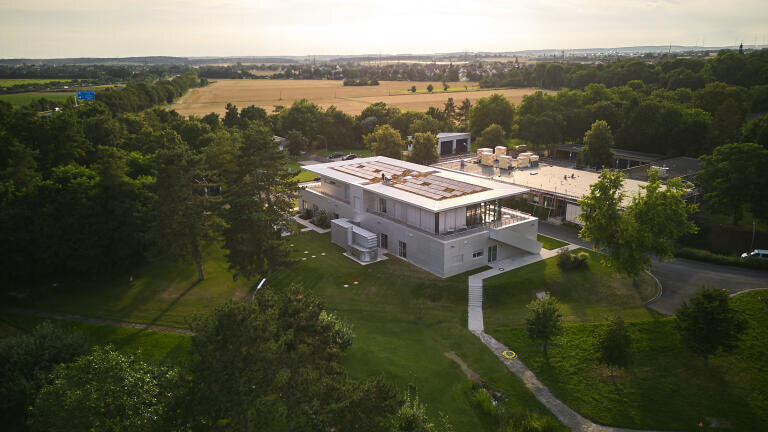
The facility is located within the grounds of the city’s existing sewage treatment plant, where an unusual bathing lake is often the first feature to attract attention during site visits. Employees use the lake to swim during the summer months but the site has also drawn interest for its modern, future-facing laboratory building and its role in wider work to address potential water shortages.
Alongside the routine operation of the sewage treatment plant, the municipal drainage system has been involved in a research initiative with the Technical University of Munich. The project aims to identify technical solutions which could help to mitigate water scarcity through the use of suitable treatment and monitoring equipment. To make wastewater suitable for reuse, controlled filtration and purification processes must be combined with reliable analytical testing to confirm that water quality remains safe.
The approach has particular relevance during dry periods without rainfall, when treated water could be used to irrigate trees, green spaces and vegetable gardens. The laboratory – with a staff of under 20 – monitor water quality at the sewage treatment plant but also carries out commissioned analytical work for industrial and private-sector clients.
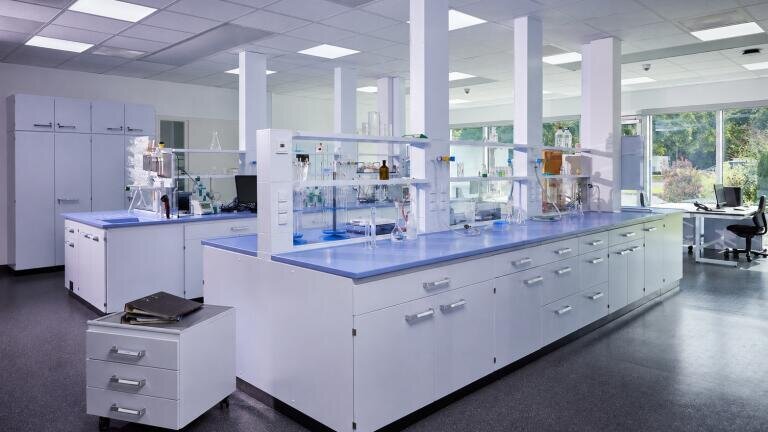
The 465 square metre building was planned and constructed by the Miller engineering office in Nuremberg. During the tender process for the laboratory fit-out, the engineering office worked with Th. Geyer, which chose Köttermann steel laboratory equipment which was selected for its high performance at a competitive price point.
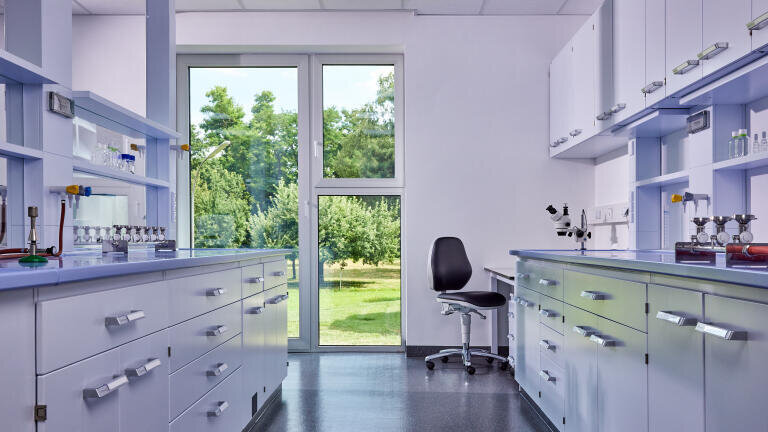
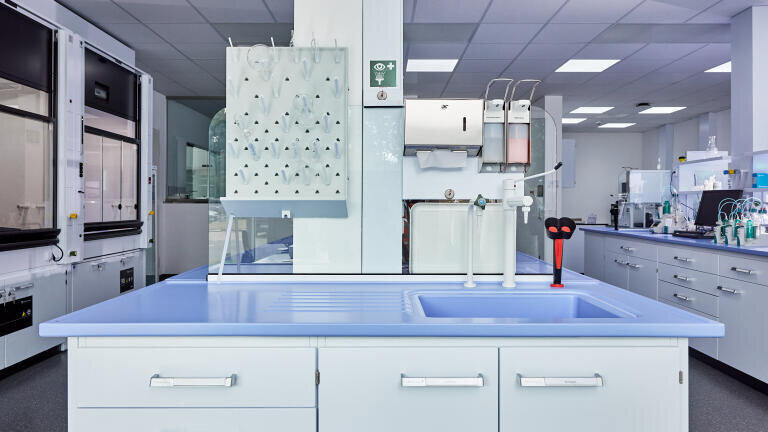
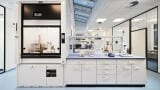
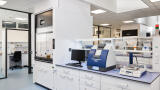
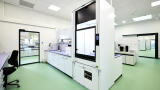
The planning process required close coordination and input from the municipal departments responsible for both drinking water and wastewater. From its outset, the building concept placed strong emphasis on light, openness and efficient workflows. Floor-to-ceiling windows allow natural light into the Köttermann-fitted laboratory areas, while the design of the workstations, media cells and laboratory fume cupboards was intended to create a coherent and open working environment.
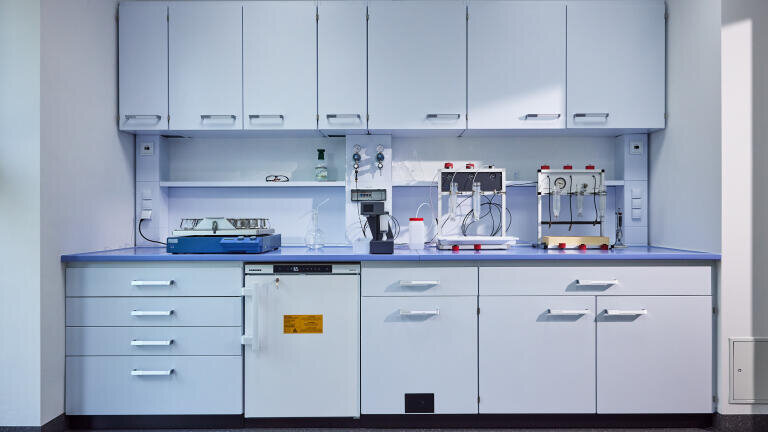
Glass inserts in the media cells helped to improve natural light and to support an open form of collaboration in the laboratory’ work. Köttermann’s custom work surfaces provide sufficient space for samples, analytical tasks and measuring instruments. Transitions between office and laboratory areas was intentionally designed to be seamless, with short internal routes set out to improve daily processes. Along the walls, tall laboratory cabinets and hazardous materials cabinets provide the storage capacity required for safe and organised laboratory operation.
“This project posed unique challenges that we have successfully navigated. Exceptional collaboration among all participants – the client, the municipal authority and suppliers like Köttermann – was the critical success factor, fostering a strong rapport with our clients,” said Sandra Niehaves, head of operational sales and laboratory furniture DACH at Th. Geyer.
The laboratory building was inaugurated in September 2023 at an event described as relaxed and celebratory. The project team had faced a series of challenges from the start but close cooperation between the parties helped to build trust throughout the fit-out phase. This relationship also allowed Th. Geyer to use an on-site office during the project, an arrangement described as exceptional for the company.
“It is rare for us to have an office at our clients’ locations. At the inauguration, the joy of [the lab’s] employees – and also the Mayor of Schweinfurt – were a most significant outcome for us,” Niehaves added.
ILM 51.6 Sept 2026



 Product directory
















.jpg)
