Laboratory products
The demand for diagnostic testing has been steadily rising over the past the last two decades and that trend is likely to only accelerate in the future.1 This increased demand for testing is driven by several key factors: aging global populations requiring increased chronic disease management, a shift towards proactive early diagnosis, and movement towards policies favouring blood based monitoring.2 These tests can have real world consequences for patients, making analytical accuracy critical. A false positive can cause immense unnecessary stress, while a false negative risks a condition going untreated.
To meet the demand for analytical accuracy, clinical laboratories are shifting away from traditional immunoassays towards Liquid Chromatography Mass Spectrometry (LC-MS) due to its superior specificity, expanded linear ranges and the ability to measure multiple analytes in one run.3 However, using LC-MS in diagnostic workflows can present unique challenges as the majority of these tests rely on complex biological matrices, such as plasma, serum, or whole blood.4 Therefore, robust sample preparation becomes a critical step, ensuring the sample is sufficiently clean and compatible to get accurate LC-MS data.
While protein precipitation (PPT) is routinely used to remove proteins, it does not remove phospholipids from a sample. These endogenous compounds are a large source of unpredictable ion suppression in LC-MS workflows, severely reducing assay sensitivity. Maintaining high sensitivity is critical when measuring analytes at low ng/mL or pg/mL concentrations, where even a slight drop in signal could result in a false negative. Phospholipid concentrations can also vary drastically between patients5 or even between longitudinal samples (samples taken at different time points from the same patient)6 which can lead to highly inconsistent responses for the target analyte. In addition to compromising data quality, the gradual build-up of phospholipids on HPLC columns and mass spectrometer components can lead to premature column death, increased instrument maintenance, and costly laboratory downtime.
Implementing phospholipid removal (PLR) products into an LC-MS workflow is the most effective strategy to remove both proteins and phospholipids from complex biological samples. Complete removal of phospholipids leads to superior sensitivity and robustness of a method. For example, figure 1 demonstrates how using PSL’s Microlute® PLR plate eliminated phospholipids in the sample mitigating the signal suppression which was present with the protein precipitation sample.
To find out more, read the application note presenting a comparative study of ion suppression effects in LC-MS using protein precipitation and phospholipid removal.
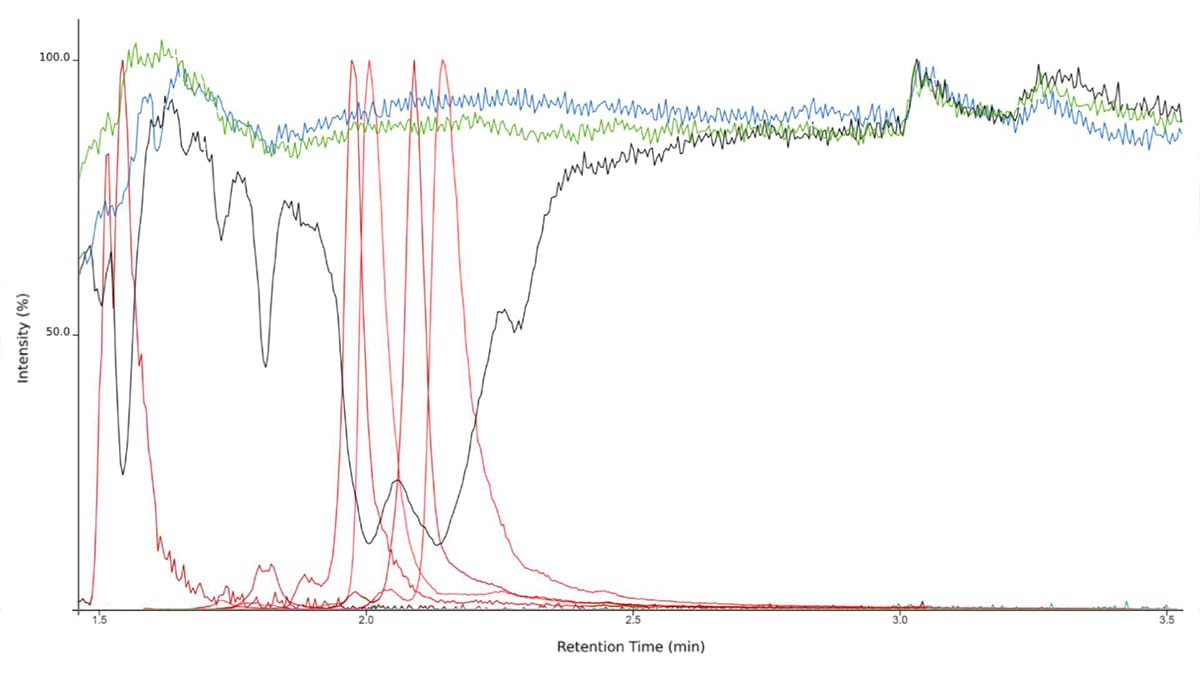
Figure 1 - Overlay of procainamide infusion chromatograms: solvent blank (green), Microlute® PLR plate (blue), protein‑precipitated sample (black), and protein precipitation phospholipid MRM trace (red).
References
ILM 51.6 Sept 2026


 Product directory


.jpg)
.jpg)










.jpg)
.jpg)
.jpg)