
Laboratory products
Tissue homogenization is often treated as a routine preliminary step, yet it can influence the quality and reproducibility of the entire analytical workflow.
The objective is not simply to break down visible tissue, but to obtain a uniform suspension while consistently releasing intracellular proteins, DNA, or RNA. Incomplete homogenization can reduce extraction yield and increase sample-to-sample variability. On the other hand, excessive processing may generate heat, promote foaming, or damage sensitive analytes.
A reliable homogenization method must therefore achieve effective cell disruption without compromising the biological material being investigated.
Rotor-stator dispersers process samples by repeatedly drawing tissue and liquid into a high-shear zone. The material is reduced in size and recirculated throughout the vessel, progressively producing a more homogeneous suspension.
However, selecting an rpm value alone is not enough to define a reproducible method.
Performance also depends on several factors, including:
Fibrous, elastic, or fatty tissues, for example, may behave very differently from softer biological samples. The dispersing tool must therefore be matched to both the application and the working volume.
Consistent tissue pre-cutting and a controlled sample-to-buffer ratio can further reduce variability before homogenization even begins.
Many homogenization problems result from incorrect tool positioning or excessive processing.
The dispersing head should remain sufficiently immersed to ensure continuous sample circulation, without touching the vessel walls or bottom.
A tool positioned too close to the surface can draw air into the sample, generating foam and potentially accelerating oxidation.
Unsuitable vessel geometry can also create stagnant zones where tissue remains insufficiently processed.
Speed should be increased progressively until stable recirculation is obtained. Since mechanical energy is converted into heat, temperature should be monitored and controlled using short or pulsed processing cycles, pre-cooled buffers, or an external cooling bath when required.
Rather than relying on processing time alone, laboratories should define an endpoint based on suspension uniformity, particle size, and downstream extraction performance.
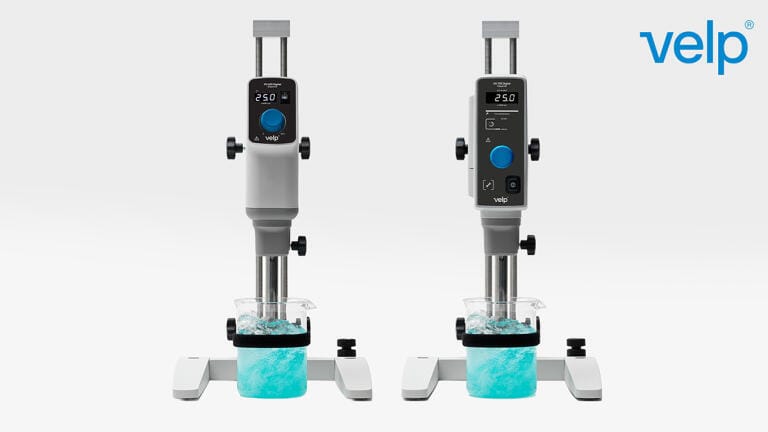
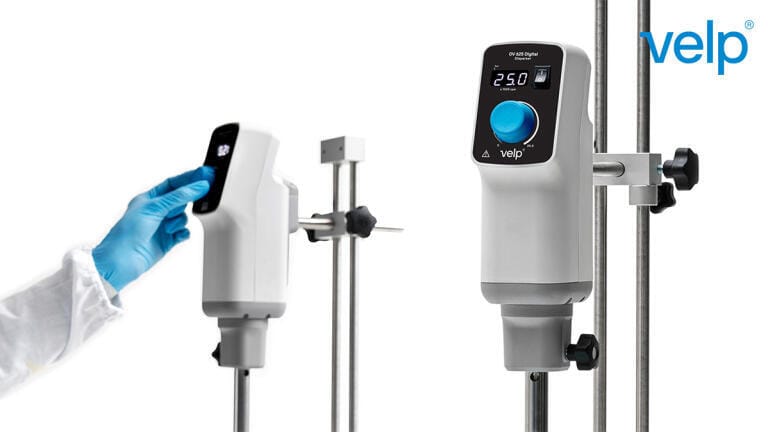
Velp dispersers provide rotor-stator homogenization solutions with tools designed for different sample volumes and preparation requirements.
The materials in contact with the sample across the Velp disperser range are AISI 316L stainless steel and PTFE, both characterised by high chemical inertness and well suited to thorough cleaning. This supports effective removal of residues and helps minimise cross-contamination between samples. Nucleic-acid workflows may additionally require DNase- or RNase-free procedures.
Once a homogeneous sample has been obtained, controlled steps such as incubation, enzymatic digestion, or nucleic-acid denaturation can be performed using the Velp ECODryBlock.
Combining controlled mechanical dispersion, suitable contact materials, and precise thermal treatment helps transform tissue homogenization from a potential bottleneck into a standardised and reliable part of the analytical workflow.
Discover Velp solutions for controlled sample homogenization and temperature-controlled preparation, and find the configuration suited to your application.
Contact the specialists to discuss how to optimise your workflow.
ILM 51.6 Sept 2026


 Product directory


.jpg)
.jpg)










.jpg)
.jpg)
.jpg)
.jpg)