Research news
Researchers in Zurich have developed biohybrid microrobots that combine neural progenitor cells with magnetoelectric nanoparticles, to guide regenerative cells to spinal cord injuries and stimulate nerve repair without implanted electrodes
A research team led by Professor Salvador Pané i Vidal of the Multi-Scale Robotics Lab at ETH Zurich, Switzerland, has developed a biohybrid microrobot system that combines therapeutic stem cells with magnetoelectric nanoparticles to repair spinal cord injuries. The approach aims to guide regenerative cells directly to injury sites and stimulate their development into nerve cells without implanted electrodes or cables.
Spinal cord injuries often cause permanent disability because nerve cells in the spinal cord have limited capacity to regenerate. Scar tissue that forms after injury can further inhibit the regrowth of nerve fibres. Although electrical stimulation of transplanted stem cells has shown promise, current methods often require invasive hardware and do not always ensure that transplanted cells survive, integrate into tissue or differentiate effectively.
The ETH team combined neural progenitor cells which can develop into cells of the nervous system with specially engineered nanoparticles. The neural progenitor cells were derived from induced pluripotent stem cells which are mature cells reprogrammed to regain stem cell-like properties.
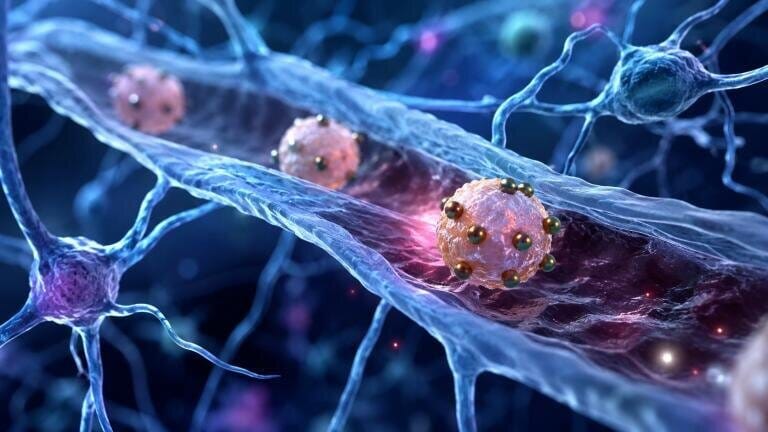
The resulting structures – termed NPCbots – consisted of neural progenitor cells linked to nanoparticles with two layers. An inner layer responded to magnetic fields, while an outer layer converted that response into electrical signals. This design enabled researchers to use external magnetic fields both to steer the microrobots and to stimulate the attached cells electrically after they reached the injury site.
The NPCbots were produced in specialised lab-on-chip systems where cells were trapped in a central reservoir before nanoparticles were introduced and allowed to bind to them.
“We place a reservoir in the centre where we trap the cells. Then we inject the nanoparticles and wait for the two components to bind,” said Vidal.
After about 30 minutes, the microrobots were ready for use with each measuring around six micrometres. Large-scale production was achieved through parallel operation of multiple lab-on-chip devices, allowing for the manufacture of the hundreds of thousands of NPCbots that are needed for cell studies and then the millions required for animal experiments.
The researchers first tested the system in zebrafish larvae with spinal cord injuries. After direct injection of NPCbots into the injury site and exposure to electromagnetic fields, the animals regained nearly normal swimming and exploratory behaviour within three days.
“Stephan Neuhauss and Jingjing Zang at the University of Zurich did extremely valuable work. They enabled us to demonstrate, in a well-characterised regenerative model system, how quickly cells differentiate using our method and how our bots repair the spinal cord,” Vidal said.
The team then evaluated the technology in mouse models with completely severed spinal cords. After 28 days, the researchers reported reconnection of nerve cells at the injury site. Treated mice also showed progressive improvements in gait, stride length, coordination and exploratory behaviour.
The treatment appeared well tolerated, with no evidence of adverse effects or immune reactions. The researchers attributed the benefits to electrical stimulation generated by the magnetoelectric nanoparticles which converted external magnetic signals into electrical impulses that promoted differentiation of transplanted neural progenitor cells.
The approach could overcome some limitations of conventional electrical stimulation. Because the spinal cord is highly sensitive, eliminating implanted electrodes may reduce invasiveness and improve treatment precision.
“Microrobotic guidance makes the treatment more precise and minimally invasive,” said Hao Ye, senior scientist and first author of the study.
Magnetic fields are particularly attractive for this application because they can penetrate biological tissues and can be adjusted through frequency and field strength. The researchers also reported that, following stimulation and differentiation, the NPCbots effectively dissolved within the tissue. The nanoparticles are expected to remain stable and minimally reactive because of their barium titanate coating, although further studies will need to determine how they are degraded or eliminated over time.
The technology remains at a preclinical stage and will require extensive testing before evaluation in humans. Researchers must identify the most effective magnetic field parameters, determine optimal stimulation durations and assess long-term safety and biological effects.
“In addition to many clinical aspects, we first need to test which magnetic fields work best in humans and determine the optimal stimulation duration,” said Hao Ye.
Beyond spinal cord repair, the team believes the platform could support other regenerative therapies. Potential future applications include cardiology, oncology, wound healing and other areas where precise cell delivery and localised stimulation are required.
“The reproducible and scalable production of microrobots using our lab-on-chip system demonstrates that the platform’s application potential extends beyond basic research,” Vidal concluded.
For further reading please visit: 10.1038/s41563-026-02625-3
ILM 51.6 Sept 2026



 Product directory




















,-photo-Karin-Allander.jpg)







.jpg)
