Research news
Newcastle University scientist presents rugged, affordable microscope design with plans for parabolic flights and sounding rocket missions
As many nation’s space agencies prepare to send astronauts back to the Moon and onward to Mars, researchers have sought to understand how living cells behave in the absence of gravity. A team led by Dr Adam Wollman at Newcastle University has developed a robust, affordable microscope that can capture real-time images of cells during the intense conditions of zero-gravity flight. The group has made the design openly available in order to widen access to microgravity research.
“We know that astronauts’ cellular signalling processes – such as insulin signalling – are affected by exposure to zero gravity,” said Wollman, an assistant professor at Newcastle University’s Biosciences Institute.
“But no one had tried to look at this in a simple, stripped-down system. We wanted to watch a cell sense and respond to a signal in zero gravity to see exactly what happened,” he added.
Spaceflight alters many aspects of human physiology, from bone density to immune function. At the cellular level, gravity influences how molecules move, how membranes organise themselves and how signalling pathways transmit information. For example, insulin signalling depends upon the precise orchestration of receptors and intracellular proteins. Even subtle shifts in physical forces can change how quickly and efficiently these molecular interactions occur. Despite decades of human spaceflight, direct observation of live cellular responses under true microgravity has remained a challenge.
Existing space-qualified microscopes, including those aboard the International Space Station, have offered powerful imaging capabilities but have tended to rely on highly specialised and expensive systems. Access to such platforms has often proved limited. Wollman and colleagues therefore set out to design a system that could operate under microgravity yet remain sufficiently simple and affordable to encourage broader participation.
“We wanted to make something more democratic where other researchers could carry out microgravity experiments that require microscopy,” Wollman said.
“We based our design on an open-source microscope from Stanford and reduced the cost to increase accessibility.”
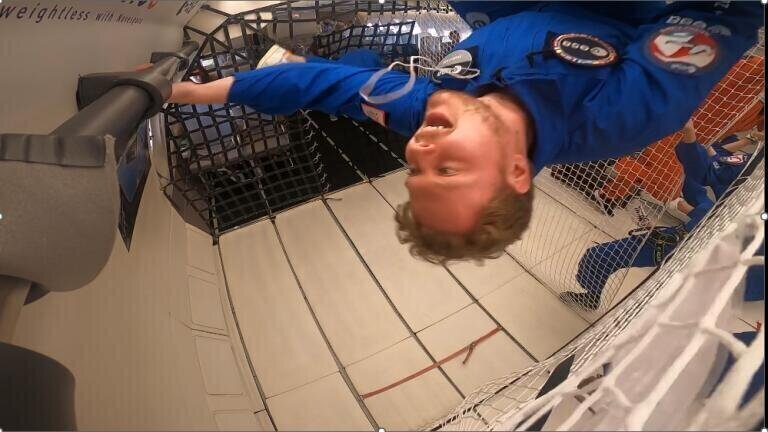
The resulting instrument – named FlightScope – was selected to fly on a parabolic flight operated by the European Space Agency. These flights, sometimes referred to informally as the ‘vomit comet’, involve a specially modified aircraft that follows steep parabolic arcs. During each arc, the aircraft climbs sharply before descending in a controlled dive, which creates approximately 20 seconds of weightlessness. Although this method has provided an accessible route to conduct microgravity experiments, the rapid transitions between hypergravity and weightlessness place considerable mechanical stress on scientific equipment.
To ensure reliability, the team installed rigid mountings and vibration-damping components within the microscope. They also incorporated a custom fluid-handling system to permit rapid exchange between experimental conditions during successive dive cycles. Such engineering considerations have proved essential, as repeated exposure to fluctuating gravitational forces can disrupt optical alignment and compromise image stability.
The researchers selected yeast as a model organism because it provides a well-characterised and tractable system for cellular signalling studies. During the parabolic flights, the microscope captured images of yeast cells that absorbed fluorescently labelled glucose molecules. Preliminary observations suggested that glucose uptake appeared slower under microgravity than under normal terrestrial conditions. Although further experiments will be required to confirm and quantify this effect, the findings indicate that gravitational forces may influence fundamental metabolic processes.
FlightScope testing has not been confined to aircraft-based experiments. Wollman has taken the instrument to the Boulby Underground Laboratory in North Yorkshire, an underground facility located within the Boulby potash and salt mine. This environment serves as an analogue site for lunar and Martian conditions because it provides isolation, low background radiation and geological features that resemble those found on other planetary bodies. There, the team has collaborated with researchers who study salt-tolerant microorganisms known as archaea. Such organisms can thrive in extreme conditions and have attracted interest in the search for extraterrestrial life.
“We are now developing another version to go on a sounding rocket. These are small rockets that fly to about 80 kilometres and then return to Earth, which gives us about two minutes of microgravity.
The larger goal is to use this technology in zero gravity for extended periods,” Wollman said.
Sounding rockets offer a bridge between brief parabolic flights and long-duration orbital missions. By placing compact experimental payloads on suborbital trajectories, researchers can obtain several minutes of continuous microgravity without the cost and complexity associated with crewed spaceflight. If FlightScope proves capable of reliable operation under such conditions, it could support longer-term studies on orbital platforms in the future.
The capacity to observe cells directly under microgravity has implications that extend beyond astronaut health. Long-duration missions will rely on microorganisms to produce food, recycle waste and synthesise pharmaceuticals. Cellular systems that function efficiently on Earth may behave differently in space. A detailed understanding of these changes will therefore prove essential to design stable life-support and biomanufacturing systems.
By combining open-source principles with pragmatic engineering, FlightScope represents a practical step towards broader participation in space biology. As agencies and private companies prepare for sustained human presence beyond Earth, tools that permit direct, real-time observation of cellular behaviour in microgravity may help to ensure that life can not only survive but function effectively far from its home planet.
For further reading please visit: 10.1038/s41526-025-00470-3
ILM 51.6 Sept 2026




 Product directory

















,-photo-Karin-Allander.jpg)