Research news
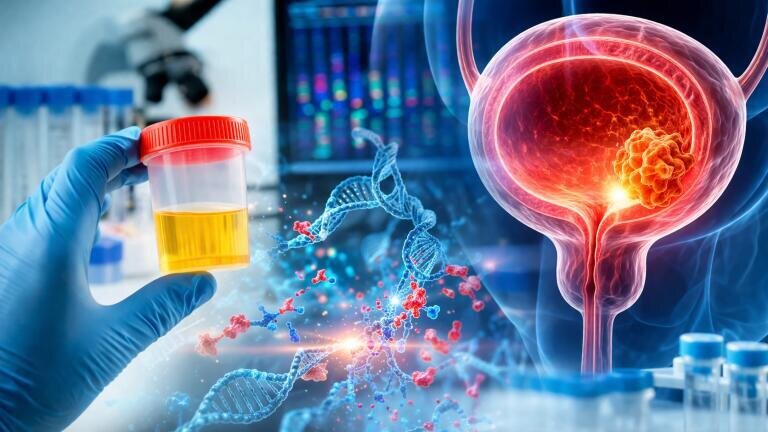
A refined liquid biopsy that accounts for age-related background mutations has enabled clinicians to identify patients with non-muscle invasive bladder cancer who could benefit from immunotherapy
Bladder cancer, which arises from the epithelial lining of the bladder, remains one of the most frequently diagnosed malignancies. The majority of cases present as non-muscle invasive bladder cancer, in which tumours remain confined to the inner layers of the organ. Although detection at this stage has often allowed early intervention, recurrence continues to present a persistent clinical challenge.
Each year, up to 500,000 patients worldwide receive a diagnosis of non-muscle invasive bladder cancer. Following transurethral resection of bladder tumour, patients with high-risk disease have typically received intravesical immunotherapy with Bacillus Calmette-Guérin (BCG). This approach, which has remained in use for decades, has reduced recurrence risk in some cases, yet others have relapsed despite treatment. Clinicians have lacked a reliable method to identify which patients fall into each category.
This uncertainty has carried clinical and logistical consequences. BCG therapy – the same live, attenuated strain of Mycobacterium bovis that is also a vaccine against tuberculosis – has produced significant adverse effects in some patients and global shortages have constrained supply. For individuals whose disease has ultimately recurred, reliance on visible tumour return has delayed intervention and reduced the opportunity to alter disease course at an earlier stage.
Now a study by investigators from the Stanford University Departments of Urology and Radiation Oncology, in collaboration with the Stanford Cancer Institute, California, USA, has presented a molecular strategy to address this gap. The researchers have developed a non-invasive urine-based assay that has identified minimal residual disease and stratified patients according to their likelihood of benefit from immunotherapy. The work has received primary support from the National Cancer Institute.
Liquid biopsy approaches have already shown potential to transform cancer monitoring by detecting tumour-derived DNA fragments in bodily fluids. In bladder cancer, urine offers a direct and accessible medium in which to detect such signals. However, the Stanford team identified a critical biological confounder. Age-related mutations can accumulate in otherwise healthy bladder epithelium, a phenomenon the researchers described as ‘clonal cystopoiesis’. These mutations can release altered DNA into urine and create false signals that resemble tumour-derived material.
To address this limitation, the investigators developed a statistical framework to filter out background mutations associated with clonal cystopoiesis. This correction has enabled the assay to distinguish genuine tumour-derived DNA from non-malignant signals with greater specificity.
“Our test can detect minimal residual disease non-invasively after bladder cancer treatment, while accounting for mutations present in normal urothelium that has complicated prior studies,” said Dr. Joseph Liao, the Kathryn Simmons Stamey Professor of Urology and co-senior author of the study.
“For the first time, we were able to distinguish patients likely cured by BCG from those cured by surgery,” he said.
Application of the assay in a prospective patient cohort has demonstrated strong predictive performance. Patients who retained detectable tumour DNA following completion of BCG therapy showed an almost certain likelihood of recurrence. By contrast, patients whose tumour DNA became undetectable after treatment experienced favourable outcomes with low recurrence risk.
Notably, the assay has identified recurrence risk in cases where conventional cystoscopic examination appeared normal which suggests that molecular detection may precede visible tumour formation and allow earlier clinical intervention.
Longitudinal analysis of urine samples collected before and after surgery, and also following immunotherapy revealed three distinct molecular response patterns. Some patients showed complete clearance of tumour DNA after surgery alone which indicated surgical cure. Others retained detectable tumour DNA after surgery but showed a reduction following BCG therapy which indicated immunotherapy responsiveness. A third group exhibited persistent or increasing tumour DNA levels despite treatment, which identified non-response.
“By correcting for the field effect, a known confounder of mutation-based bladder cancer detection, we improved the specificity of urine tumour DNA liquid biopsies,” said Dr. William Shi, co-lead author and researcher at Stanford School of Medicine.
“This allowed us to molecularly distinguish the relative contributions of surgery and BCG to disease control,” he added.
Analysis indicated that tumours resistant to surgery exhibited gene expression patterns associated with proliferation and invasion. By contrast, tumours that responded to immunotherapy showed higher mutational burden and evidence of pre-existing immune activity which suggested increased immunogenic visibility.
“The ability to distinguish responders from non-responders to the two treatments also allowed us to study which molecular properties make tumours more likely to benefit from each therapy,” said Dr. Max Diehn, the ‘Jack, Lulu and Sam Willson’ professor of radiation oncology and co-senior author.
The findings have also clarified why previous efforts to identify predictive biomarkers for BCG response have yielded inconsistent results. Inability to distinguish between surgical cure and immunotherapy response has obscured interpretation of molecular signals.
Current clinical practice has treated most intermediate- and high-risk patients with BCG after surgery because clinicians have not been able to determine whether microscopic disease remains. The present study has suggested that a urine-based assay informed by correction for the field effect could refine this approach. It could enable clinicians to identify patients who have achieved molecular cure after surgery and therefore avoid unnecessary immunotherapy, prioritise treatment for those most likely to benefit.
“These kinds of predictive biomarkers are critical,” said Dr. Eila Skinner, the ‘Thomas A. Stamey’ research professor of urology and chair of Stanford’s department of urology.
“We have treatments that are costly and carry risk of side effects. We would love to personalise therapy to ensure each patient receives the best treatment for their individual cancer,” she said.
In clinical terms, the approach has supported earlier and more targeted intervention for patients at highest risk of recurrence while reducing overtreatment in those unlikely to benefit from additional therapy. Beyond bladder cancer, the work has broader implications for the development of liquid biopsy technologies. Similar field effects have been observed in lung and colorectal epithelium which indicates that age-related background mutations may require systematic correction across multiple cancer types.
For further reading please visit: 10.1016/j.cell.2025.12.054
ILM 51.6 Sept 2026



 Product directory
















,-photo-Karin-Allander.jpg)







.jpg)
