Research news
Published over 2 years ago. See the latest and most current information on Research news.
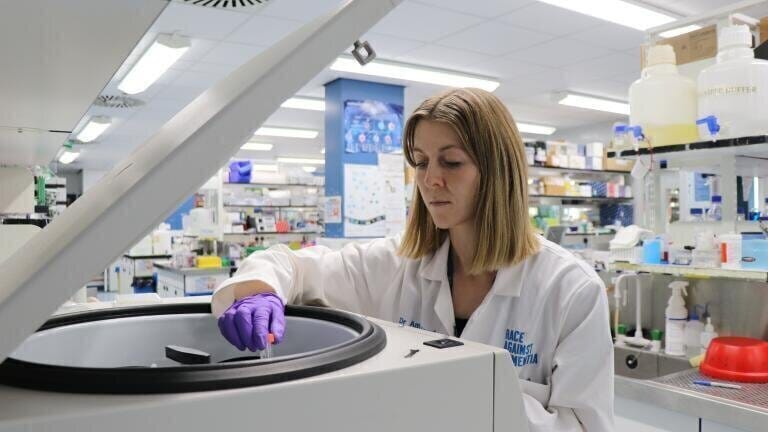
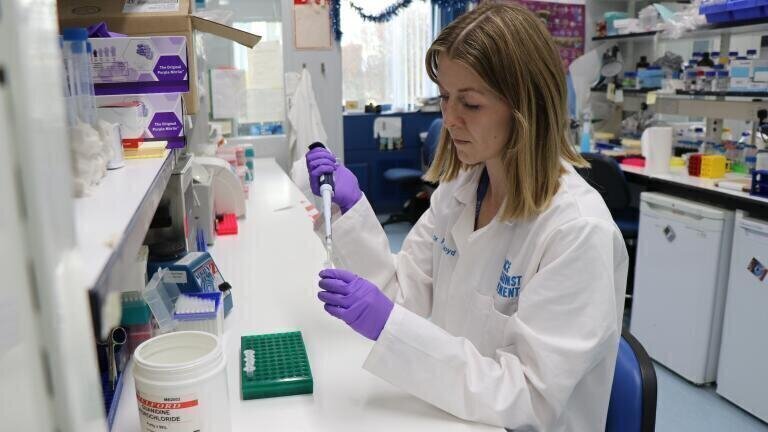
University of Dundee neuroscientist Dr Amy Lloyd is one of a handful of scientists who have turned to mass spectroscopy to study brain behaviour in patients with Alzheimer’s disease, by analysing microglia cells. Normally functioning to protect the brain, these cells were found to ‘turn bad’ and start to cause damage in patients with Alzheimer’s.
“We currently don’t know why the microglia switch from protecting to damaging the brain in Alzheimer’s patients,” said Amy. “My research is trying to understand how and why they do that. What changes to make them damaging and what pathways are being activated. If we can learn that, then we can treat it to stop these pathways being opened and stop the development of the disease.”
The University’s School of Life Sciences is one of a small number of research labs in the UK to contain a mass spectrometry and Amy, who was awarded a five-year research fellowship from Race Against Dementia and Alzheimer's Research UK last May, hopes to fully understand this cell’s normal and abnormal behaviour, with a view to one day developing new treatments for the condition.
She added, “A build-up of sticky plaques on the brain, called amyloids beta, are known to cause dementia in humans.
“The microglia can clean them away when they are functioning normally but something happens in Alzheimer’s to stop them doing that and the amyloid proteins stick together and cause damage. There is lots of research going on into amyloid plaques, but very few people are looking at microglia through the use of mass spectrometry.”
Originally from Staffordshire, her interest in dementia started when she was studying for her undergraduate degree in neuroscience at the University of Nottingham, at which time she also worked as a carer for patients with dementia; “As a 19 or 20-year old, I was looking after people who used to be independent, had children and grandchildren and had lived a full life,” she said. “And they had a young woman like me looking after them – it didn’t feel right. I felt like I wanted to do something about it.
She went on to study an MSc in Oncology at Nottingham and took up a PhD at the University of Edinburgh.
Having studied the role of microglia in multiple sclerosis (MS) patients, she then joined the University of Dundee as a UK Dementia Research Institute Postdoctoral Research Fellow.
More information online
ILM 51.6 Sept 2026



 Product directory




















,-photo-Karin-Allander.jpg)




.jpg)



.jpg)
