Research news
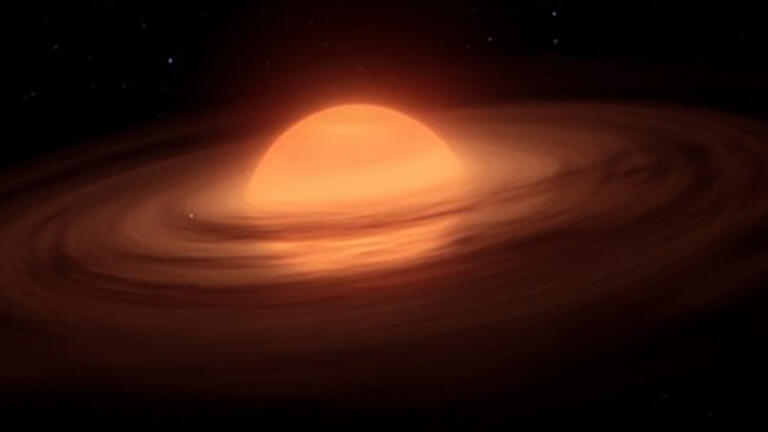
New research from the School of Physics and Astronomy at the University of St Andrews, in collaboration with teams from the USA, Italy, Ireland, England, and Portugal, suggests that giant free-floating planets—planets not bound to any star—could form their own miniature planetary systems. The findings have been published in The Astronomical Journal [1].
Using the James Webb Space Telescope (JWST), the team studied young isolated objects with masses 5-10 times that of Jupiter. Unlike typical giant planets, these ‘rogue’ worlds drift through space alone, making them faint and challenging to observe, radiating mostly in infrared light.
By analysing eight of these planetary-mass objects, researchers discovered that six are surrounded by disks of warm dust - a key ingredient for planet formation. Spectroscopic observations revealed silicate grains showing signs of dust growth and crystallisation, the very first steps in forming rocky planets. While such silicate emissions have been observed around stars and brown dwarfs before, this is the first detection in free-floating planetary-mass objects.
Dr Aleks Scholz, Principal Investigator, said: “These studies suggest that objects with masses comparable to giant planets could host their own miniature planetary systems. They might resemble the solar system, just scaled down by a factor of 100 or more.”
Lead author Dr Belinda Damian added: “The building blocks for planets can exist even around lonely worlds barely larger than Jupiter. Planetary systems may not be exclusive to stars - they might also form around starless planets drifting through space.”
The findings offer a fresh perspective on planetary formation and hint at a hidden population of miniature systems floating freely in the galaxy.
More information online
1. Spectroscopy of Free-Floating Planetary-Mass Objects and their disks with JWST published in The Astronomical Journal, DOI 10.3847/1538-3881/adea50
ILM 51.6 Sept 2026




 Product directory



















,-photo-Karin-Allander.jpg)


.jpg)

.jpg)